


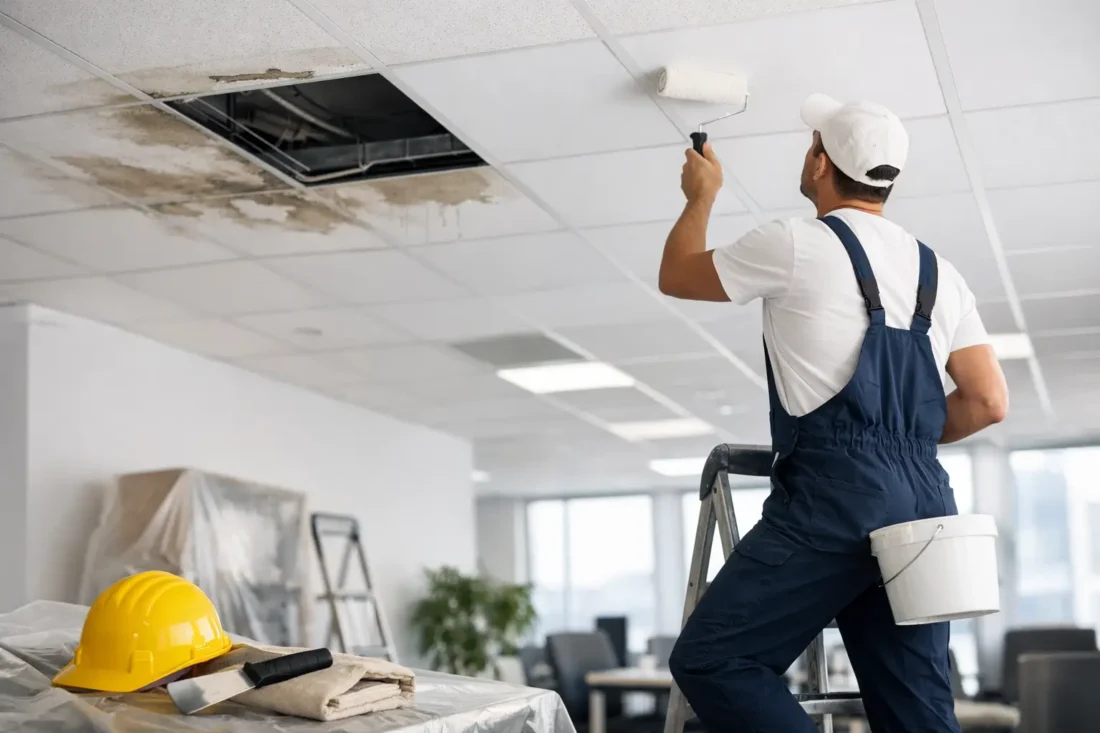
Ceiling Restoration After Tenancy Explained
A ceiling is easy to ignore until handover week, when exposed wiring, mismatched tiles, patched boards and old light cut-outs suddenly become a landlord issue. Ceiling restoration after tenancy is one of the most closely checked parts of commercial reinstatement because it affects appearance, fire safety, M&E coordination and whether the space is truly back to its agreed original condition.
For offices, shops, clinics and other leased premises, ceiling works are rarely just about replacing a few panels. Once fit-out items are removed, hidden defects often appear. Previous alterations to lighting, air-conditioning, sprinklers, speakers, sensors, partitions and signage may all leave marks behind. If those points are not properly reinstated, the landlord or building management may reject the unit, request additional rectification, or hold back deposits while the issue is resolved.
Why ceiling restoration after tenancy matters
At lease end, landlords are not judging the ceiling in isolation. They are looking at whether the entire unit has been returned in a clean, safe and consistent condition. The ceiling is one of the clearest indicators of workmanship because poor reinstatement is easy to spot – uneven paint, misaligned grid lines, patched openings, stained boards or visible service rerouting all stand out immediately.
There is also a practical reason this area gets attention. Ceiling systems sit around essential building services. A careless removal or rushed patching job can affect lighting points, smoke detectors, diffusers, fire sprinklers and access panels. That creates a compliance problem, not just a cosmetic one. In commercial properties, especially managed buildings, anything that touches these systems may need to align with tenancy requirements and building management procedures.
For tenants, the risk is straightforward. A small defect in the ceiling can trigger repeat visits, delays to final inspection and extra cost at the point when the business is already trying to move out, settle accounts and return possession on time.
What landlords usually expect
The starting point is always the tenancy agreement, approved fit-out drawings and any handover documentation from the start of the lease. Some units must be returned to bare shell condition. Others need to go back to a basic fitted state, such as suspended ceiling in place, standard lighting restored, and all tenant-added fixtures removed.
That distinction matters. In one unit, removing the false ceiling entirely may be correct. In another, the landlord may expect the suspended ceiling grid, boards and standard service layout to remain or be reinstated. Assumptions are where costly mistakes happen.
A proper review should clarify the ceiling type, the original layout, what was added by the tenant, and what needs to stay, be removed or be rebuilt. This avoids over-reinstatement as well as under-reinstatement. Both waste money.
Common ceiling issues found during reinstatement
The most frequent problem is leftover openings after the removal of lights, exit signs, CCTV, speakers, feature fittings or display supports. Even when these openings are patched, poor matching can leave the ceiling looking pieced together rather than restored.
Another common issue is damage caused by dismantling partitions that were tied into the ceiling. Once the partition is removed, the ceiling line above it may reveal missing boards, uneven framing, paint differences or disruption to the grid system. In retail and office units, this is especially common where layouts changed more than once during the lease.
Staining is another concern. Water marks from old condensate issues, discoloured paint around air-conditioning diffusers, and dirt accumulation around service points can lead to rejection even if the structure is intact. Landlords usually expect a uniform finish, not a ceiling that shows the history of every previous alteration.
There can also be hidden coordination issues. Remove one fixture and you may discover unsupported cabling, disconnected services, or ad hoc fixing methods above the ceiling. These need proper rectification, not just concealment.
How ceiling restoration after tenancy is usually carried out
The right approach begins with a site assessment, not immediate patching. A contractor should review the existing ceiling condition, compare it against lease and landlord requirements, and identify all associated trades that affect the ceiling area. This often includes electrical, ACMV, fire protection and sometimes plumbing works.
Removal comes first. Tenant-installed fittings, decorative features, suspended items and non-original service points are dismantled carefully to avoid additional damage. If the ceiling is to remain, the objective is controlled removal. If the original requirement is bare slab, then dismantling proceeds accordingly with proper disposal and making good of affected services.
Next comes repair and reinstatement. For suspended ceilings, this may involve replacing damaged tiles or boards, reinstating the grid, closing openings, re-establishing access panels and ensuring alignment across the ceiling plane. For plasterboard or gypsum ceilings, the process is more sensitive because patching must be properly supported, jointed, skimmed and finished to avoid visible lines after painting.
Painting is usually the final visual equaliser, but it is not a substitute for proper repair. A fresh coat may hide minor variation, but uneven surfaces, poor joints and bad patch work tend to show once the paint dries and the lighting is on.
Finally, the ceiling has to be checked alongside the services within or below it. Light points, detectors, sprinklers, diffusers and trunking conditions should all match the agreed reinstatement scope. A ceiling that looks acceptable but fails inspection because service points are missing or wrongly positioned is not handover-ready.
The trade-off between speed and proper workmanship
Most lease-end projects run on a tight timeline. Businesses are moving staff, stock, equipment and operations while trying to avoid extension charges. That creates pressure to complete reinstatement fast.
Speed matters, but ceilings are one area where rushed work tends to come back. Quick patching may save a day now and cost several days later in rectification. If replacement materials do not match, if the substrate is not properly repaired, or if paint is applied before surfaces are ready, the defects usually appear during inspection or shortly after.
The better approach is controlled speed. That means sequencing works correctly, coordinating related trades, and allowing enough time for repair, finishing and quality checks. A contractor with end-to-end reinstatement capability is usually better placed to manage this because ceiling restoration sits in the middle of several technical scopes, not at the edge of them.
Why one contractor often works better than several
Ceiling defects are often caused by another trade. An electrician removes fittings and leaves cut-outs. An air-conditioning team removes diffusers and leaves stains or gaps. A partition dismantling crew exposes missing sections. If separate vendors handle each package without close coordination, responsibility becomes fragmented.
For the tenant, that means more follow-up, more site supervision and more room for dispute. One contractor says the painter should fix it. The painter says the ceiling installer should return. Meanwhile, handover dates move closer.
Using a single contractor for reinstatement reduces that risk. The ceiling is then treated as part of a full reinstatement scope, with responsibility for making good carried through from dismantling to final touch-up. That is one reason businesses in Singapore often prefer a contractor that can handle ceiling, M&E, demolition, painting, disposal and handover support under one project lead.
What to check before work starts
Before any ceiling restoration proceeds, confirm the lease requirements, existing ceiling type, material availability and all affected services. It is also worth checking whether building management has restrictions on work hours, debris removal, permit applications, wet works or service isolation.
Material matching deserves special attention. Older ceiling boards, tiles or grid systems may no longer have exact equivalents. In those cases, a contractor should advise whether a localised replacement will be visibly different or whether a wider replacement area is the more practical option. The cheapest repair is not always the most acceptable one.
It also helps to agree the inspection standard early. Are minor ageing marks acceptable, or is a fully repainted finish expected? Must all service points be returned to original drawings, or only to current landlord instruction? Clarity upfront prevents arguments later.
Choosing the right contractor for ceiling restoration after tenancy
The right contractor should understand more than ceiling installation. They need to understand reinstatement obligations, landlord expectations and handover risk. Ask how they assess the original condition, how they coordinate affected services, and how they manage defects discovered after dismantling begins.
Look for practical answers, not broad promises. A dependable contractor should be able to explain their method for patching, board replacement, grid alignment, painting, protection, debris disposal and final inspection support. If they treat the ceiling as a simple cosmetic job, that is usually a warning sign.
Office Reinstatement Singapore approaches ceiling work as part of the wider lease-end process – not as an isolated repair item. That matters because successful handover depends on every related trade being closed out properly, documented clearly and completed to the landlord’s acceptance standard.
A good ceiling restoration outcome is not the one that looks fine from the doorway. It is the one that passes inspection without debate, fits the tenancy requirement, and lets your team hand back the unit without another round of site fixes. When lease end is already demanding enough, that kind of certainty is worth planning for early.