


Commercial Flooring Reinstatement Explained
A landlord’s inspection rarely gets held up by the obvious things alone. More often, the problem sits underfoot – adhesive residue on bare concrete, mismatched vinyl patches, cracked tiles near the entrance, or carpet tiles removed without proper making good. Commercial flooring reinstatement is one of the most commonly underestimated parts of lease-end works, and one of the fastest ways for a handover to turn into a dispute.
For commercial tenants, flooring is not just a finish. It affects the reinstatement standard of the whole unit. If the floor has been altered during fit-out, whether through carpet installation, raised platforms, timber-look vinyl, epoxy coating, anti-slip treatment or heavy-use tile replacement, it usually needs to be restored to the condition stated in the tenancy agreement or landlord’s handover requirements. That sounds straightforward until the actual work begins.
What commercial flooring reinstatement usually involves
In practical terms, commercial flooring reinstatement means removing non-original floor finishes and restoring the substrate or replacement finish so the premises can be handed back in acceptable condition. The exact scope depends on what was installed, what was there originally, and what the landlord expects at surrender.
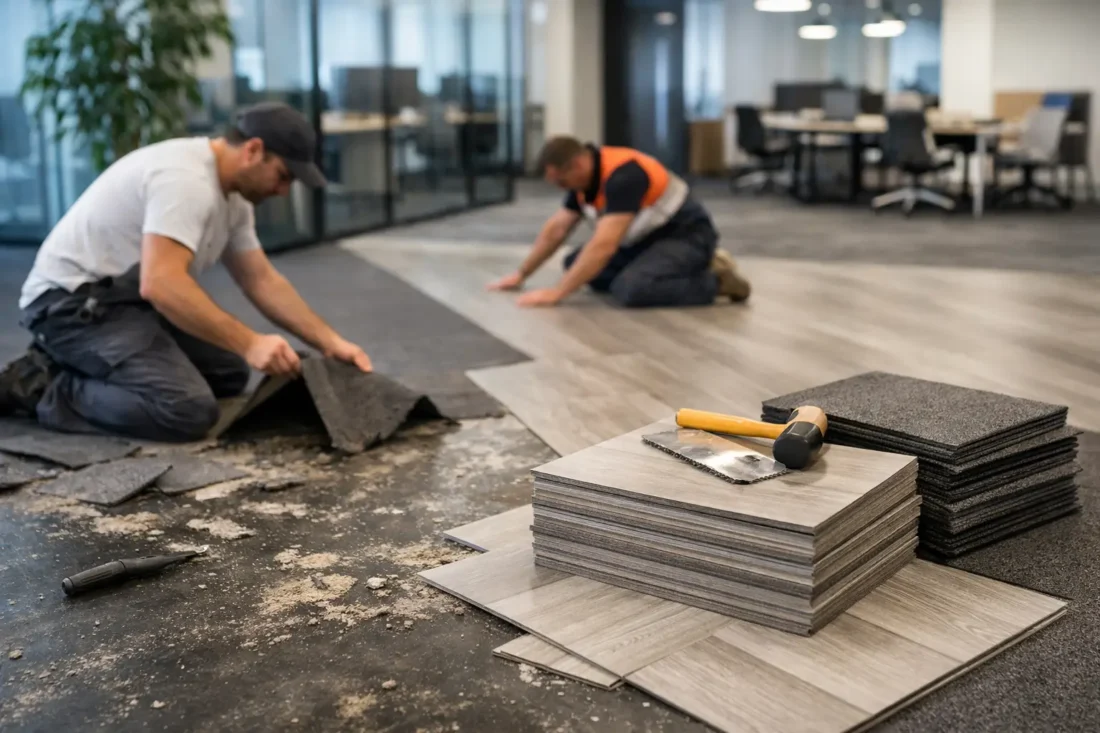
For an office, that may mean removing carpet tiles, grinding off adhesive, repairing chipped screed and repainting floor markings or replacing selected finishes to match the original base build. In a retail unit, the work may involve hacking out custom tiles, levelling the floor after platform removal, and making good transitions at shopfront areas. In clinics, gyms, restaurants and salons, reinstatement can be more technical because flooring may have been selected for hygiene, slip resistance, drainage or load-bearing needs. Once those finishes are removed, the underlying floor often needs more repair than expected.
This is where many tenants run into trouble. They assume flooring is a simple strip-out item, but removal and restoration are two different tasks. Pulling up floor material is quick. Returning the floor to an acceptable handover state is where cost, time and workmanship matter.
Why flooring defects cause handover delays
Landlords and building managers tend to look closely at flooring because it is visible, measurable and difficult to ignore. A wall can sometimes be repainted quickly after inspection. A defective floor often cannot. If there are hollows, uneven patches, exposed adhesive, poor tile alignment or obvious colour variation, rectification may take several more days and can affect access for other closing works such as cleaning and final inspection.
The main issue is that flooring defects often reveal themselves late. Once furniture is removed and lighting conditions change, imperfections become more obvious. A floor that looked acceptable during operations may fail a lease-end inspection when the unit is empty. This is especially true in open-plan offices, retail spaces with full frontage exposure, and units where sunlight highlights patchwork or level differences.
In Singapore, commercial units also operate within building management rules that may restrict hacking hours, debris removal timing, noise levels and lift usage. That means a flooring delay is not always easy to recover. If a contractor misses the permitted work window, the whole programme can slip.
The biggest mistake tenants make
The biggest mistake is treating flooring as a standalone trade instead of part of the wider reinstatement scope. In reality, floor restoration is linked to partition removal, electrical point removal, platform dismantling, ceiling reinstatement and final cleaning. If those works are not sequenced properly, the floor may be damaged again after repair.
A common example is completing floor patching before overhead dismantling is finished. Once workers bring down partitions, remove signage or haul out bulky items, fresh damage appears and the floor needs another round of rectification. The same applies when electrical conduits, plumbing runs or built-in counters are removed after flooring has already been made good.
A proper reinstatement plan stages the flooring work at the right point – not too early, not too late. That sounds basic, but it is one of the clearest differences between isolated subcontracting and a managed end-to-end reinstatement approach.
Commercial flooring reinstatement depends on the original condition
There is no single reinstatement standard that applies to every lease. Some landlords require return to base concrete slab. Others expect the tenant to match the original tiled finish or maintain a usable floor without visible defects. Some tenancy agreements describe the condition precisely, while others leave room for interpretation. That is why site inspection and document review matter before any quotation is finalised.
If the original floor was concealed
When a tenant installs new flooring over an existing base, the original condition may not be known until removal starts. Hidden cracks, moisture damage, uneven screed or previous patchwork can all surface during stripping. If the original floor is not recoverable to a reasonable standard, replacement or more extensive repair may be necessary.
If the fit-out changed floor levels
Raised platforms, wet area build-ups, feature zones and sunken service areas create another layer of complexity. Once these are dismantled, the contractor may need to rebuild floor levels, form smooth transitions and repair surrounding finishes. This is not just cosmetic. Uneven levels can become a compliance or safety issue during inspection.
If the space had heavy operational use
Warehouses, kitchens, gyms and treatment rooms often leave behind impact damage, stains, anchors or embedded fixtures. In these cases, reinstatement may require hacking, filling, grinding and surface correction before the floor is ready for handover. A light-touch patch-up approach usually does not hold up under inspection.
What a well-managed flooring reinstatement process looks like
The process starts with identifying the lease requirement, the existing floor build-up and the likely hidden conditions. After that, the work should be planned around access restrictions, debris disposal, noisy work timing and the sequence of other reinstatement trades.
Removal must be controlled. That means lifting finishes without unnecessary substrate damage, isolating dusty works where needed, and disposing of debris in line with building management rules. Once the exposed floor is visible, the contractor should assess defects immediately rather than waiting until the end.
Repair and making good come next. This may include adhesive removal, screed patching, crack repair, tile replacement, edge correction, grinding, levelling or surface finishing. The right method depends on what the handover condition requires. Not every floor needs to look new, but it does need to meet the agreed reinstatement standard.
The final stage is protection and inspection readiness. If other trades are still on site, the restored floor may need temporary protection to prevent repeat damage. Before landlord handover, the unit should be checked for visible defects under normal lighting and from key viewing angles, especially at entrances, open spans and transition points.
Why one contractor often saves more than it costs
Commercial tenants sometimes split flooring, dismantling, electrical and painting works across separate vendors to lower upfront cost. On paper, that can look economical. On site, it often creates finger-pointing when defects appear.
If the floor is chipped after partition removal, who pays? If adhesive remains because the removal team stopped short of proper making good, who rectifies it? If the floor finish cannot proceed because another trade is behind schedule, who absorbs the delay? These are routine lease-end problems.
A single reinstatement contractor with full trade coverage is usually better placed to control sequencing, workmanship responsibility and final handover quality. That matters most when time is tight and the cost of overrun includes landlord penalties, extended rent exposure or disruption to relocation plans. Office Reinstatement Singapore operates on this model because commercial handovers rarely fail on one trade alone. They fail when no one is managing the full picture.
How to judge whether your flooring reinstatement scope is adequate
If your current plan only says “remove existing flooring”, it is probably incomplete. A proper scope should account for removal, disposal, substrate repair, levelling where required, finishing or restoration to the original condition, and coordination with adjacent reinstatement works. It should also reflect building management constraints and inspection expectations.
That does not mean every project needs a full floor replacement. In some units, targeted repairs are enough. In others, especially where custom finishes were heavily bonded or the original base was damaged, partial work creates more visual inconsistency than a broader reinstatement approach. This is where practical site judgement matters more than generic pricing.
Tenants should also be realistic about timing. Flooring works can move quickly when the substrate is sound and access is clear. They can slow down significantly if hidden defects appear, noisy work permits are limited, or curing time is needed after repair. The safest approach is to assess early and leave contingency in the programme rather than assuming floor works can be squeezed into the final two days.
Commercial flooring reinstatement is not the flashiest part of a lease-end project, but it is one of the most decisive. When done properly, it supports a clean inspection, a smoother handover and fewer last-minute arguments about condition. If there is one area worth scoping carefully before vacating a unit, it is the surface every inspector will notice the moment they walk in.