


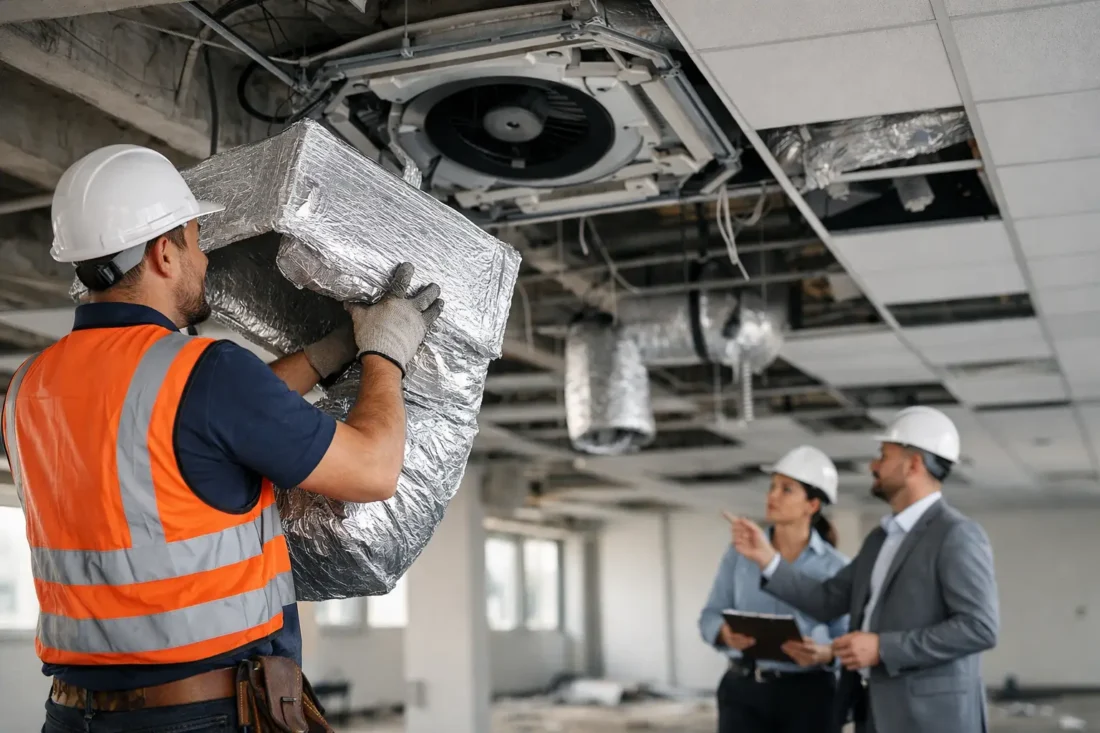
HVAC Removal Before Handover Explained
If your unit has added fan coil units, ducting, diffusers or independent air-conditioning points during fit-out, HVAC removal before handover is rarely just a matter of taking equipment down and carting it away. In many commercial leases, the landlord expects the space to be returned to base condition, with services made safe, openings closed properly, and visible finishes restored. Miss any part of that chain and the final inspection can quickly turn into a dispute, a delay, or a reinstatement bill you did not budget for.
Why HVAC removal before handover needs proper planning
Mechanical services sit at the intersection of several trades. Once an air-conditioning system is removed, there may be refrigerant handling, electrical disconnection, pipework capping, ceiling repair, wall making good, access panel reinstatement and debris disposal to deal with. If the unit connects into a landlord-controlled system, there may also be building management procedures, permit requirements and restricted working hours.
That is why HVAC removal before handover should be planned against the lease, the approved fit-out drawings and the original handover condition of the premises. Some tenants assume that if the system is working, leaving it behind is helpful. In practice, landlords often reject unauthorised additions, especially if they create future maintenance liability or differ from the building standard.
The right approach depends on what was installed in the first place. A small split unit in a back office is not the same as a branch ducted system across an open-plan workspace. A retail unit with kitchen exhaust and supplementary cooling has very different technical and compliance issues from a standard office floor.
What usually needs to be removed
In a reinstatement project, HVAC scope may include indoor units, outdoor condensers where applicable, chilled water fan coil units, supply and return ducting, flexible ducts, diffusers, grilles, thermostats, control cabling, condensate drains, insulation and associated supports. In some units, raised platforms or boxed-up bulkheads built to conceal services also need to be dismantled.
The critical point is that removal is only one part of the obligation. Landlords and managing agents usually assess whether the premises have been returned to an acceptable condition visually and technically. That means redundant power points cannot be left live, drain points cannot be left exposed, and ceiling tiles cannot be patched in an obviously mismatched way.
Start with the lease and landlord requirements
Before any dismantling begins, check the tenancy agreement, fit-out approval conditions and any reinstatement guidelines issued by building management. These documents often define whether all tenant-installed HVAC systems must be removed, whether base building services must remain untouched, and whether certain works require prior approval or supervision.
This review matters because lease language can be broader than tenants expect. A clause may require reinstatement to original layout and condition, which affects not only the equipment but also the route of ducting, control points and ceiling modifications created for the installation. If there is ambiguity, it is better to clarify it before work starts than argue over it after the inspection.
In Singapore commercial buildings, access rules also affect timing. Some properties restrict noisy works, after-hours dismantling or disposal arrangements. If mechanical plant is located in common areas or linked to central systems, there may be additional coordination with the building engineer.
Technical risks that should not be left to the last week
The biggest mistake with HVAC removal before handover is leaving it too late. Mechanical dismantling often exposes hidden conditions. Once ceiling sections are opened, you may find extra cabling, abandoned pipes, fire protection interfaces or previous alterations that were never shown on drawings.
There is also the issue of refrigerants and electrical isolation. Air-conditioning systems cannot simply be disconnected casually. Refrigerant recovery, safe handling and disposal need to be done correctly. Power supplies must be isolated and terminated properly. If condensate drainage was tied into plumbing routes, those points must be sealed and made good to prevent leakage or odour issues later.
Another common problem is finish restoration. Removing ducting and FCUs can leave staining on ceilings, anchor marks on slabs, patched walls and uneven paint tone. If the landlord is expecting a clean original-condition return, mechanical removal and cosmetic reinstatement must be coordinated as one scope rather than treated as separate, unrelated jobs.
The practical sequence for HVAC removal before handover
A compliant job usually starts with a site survey. This identifies what is tenant-installed, what belongs to the base building, where disconnection points sit, and what making-good works will follow. It is also the stage to compare actual conditions against approved plans and to flag discrepancies early.
Once the scope is confirmed, permits and access arrangements should be settled. For occupied buildings, this avoids disruption and keeps the job aligned with management rules. Equipment protection, lift usage, loading bay access and disposal timing all affect how smoothly the works proceed.
The dismantling itself should follow a controlled order. Services are isolated first. Refrigerant or chilled water interfaces are handled safely. Equipment, ducting and supports are removed without damaging retained systems. Openings are then closed, exposed terminations made safe, and surrounding finishes restored.
The final phase is often where projects are won or lost. This includes testing that remaining systems are unaffected, clearing debris, deep cleaning affected areas and checking that ceilings, walls and floors present well for inspection. If the landlord sees incomplete patching or loose service ends, the handover can still be rejected even if the equipment is gone.
Making good after removal is not optional
From a tenant’s perspective, the cost of removal can look straightforward while making good feels secondary. In reality, making good is what landlords notice first. They are not inspecting your dismantling method. They are inspecting the condition of the returned premises.
After HVAC removal, common rectification items include ceiling tile replacement, gypsum board patching, repainting, rewiring of lighting circuits affected by demolition, floor finish repairs where supports were fixed, and reinstatement of the original ceiling grid or soffit appearance. If duct routes passed through partitions, those wall sections may need full restoration rather than small cosmetic patching.
This is why a single contractor handling multiple trades is often more efficient than appointing separate mechanical, electrical, carpentry and painting teams. The work is interdependent. Delays between trades increase the chance of missed defects and repeated attendance costs.
Cost depends on more than equipment quantity
There is no sensible flat rate for HVAC removal before handover because the effort depends on system type, access conditions, disposal requirements and the level of reinstatement expected afterwards. A small office with one supplementary unit may be simple. A fitted-out commercial space with extensive ducting above a feature ceiling is a very different exercise.
Cost is also shaped by programme pressure. If your lease expiry is close and after-hours work is needed to meet building rules, the labour profile changes. If there are concealed services clashes or landlord comments after the first inspection, rectification costs can follow.
The cheapest quote is often based on a narrow removal scope with minimal making-good. That can become expensive later if patching, painting, electrical termination and final defect clearance are excluded. For lease-end projects, scope clarity matters more than headline price.
How to avoid inspection issues
The most reliable way to reduce handover risk is to treat HVAC removal as part of the full reinstatement plan, not as an isolated task. That means documenting the agreed scope, confirming exclusions, and checking the space against landlord expectations before the formal inspection.
It also helps to conduct a pre-handover walkthrough internally. Look for visible marks at removed diffuser points, mismatched ceiling panels, exposed conduits, uncapped drainage, leftover controls on walls and areas where paint colour does not blend. These are small issues individually, but they are exactly the kind of details that trigger landlord comments.
Where the premises include multiple alteration types, coordination becomes even more important. HVAC removal may affect lighting layouts, partitions, signage backing, data routes and access panels. A contractor experienced in end-of-lease reinstatement will plan these interfaces rather than waiting for one trade to discover another trade’s problem on site.
For businesses vacating offices, retail units, clinics or industrial spaces, the real objective is not simply to remove equipment. It is to return the premises in a condition that can be accepted without argument. That is the difference between a mechanical dismantling job and a handover-ready reinstatement scope.
Office Reinstatement Singapore handles this as an end-to-end process, so HVAC removal, making good, debris disposal and inspection preparation are coordinated under one scope instead of split across multiple parties.
If your lease is nearing expiry, the safest move is to review the HVAC scope early, confirm what must stay and what must go, and programme the works with enough time for proper restoration. A clean handover usually comes down to the details you sorted before anyone arrives for the final inspection.