


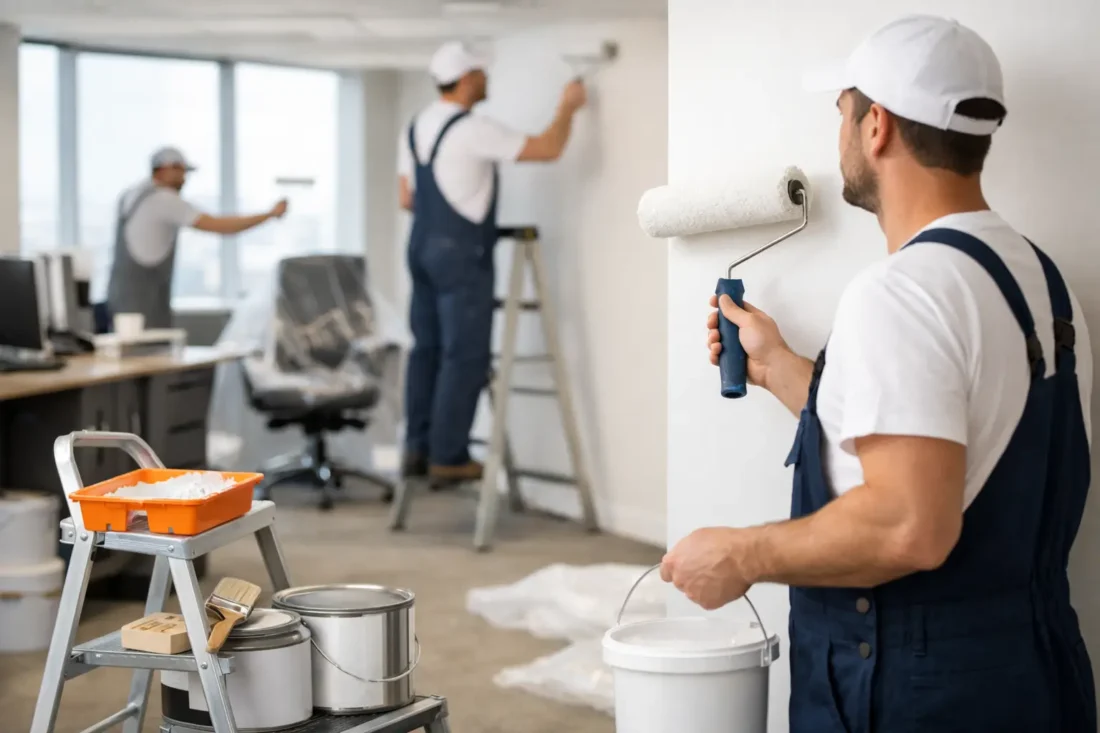
Office Painting Services for Lease-End Handover
A freshly painted office can still fail a landlord inspection if the colour is wrong, unauthorised feature walls remain, or previous fit-out damage has merely been covered over. Office painting services at lease end are not just about making a unit look clean. They are part of the reinstatement scope required to return the premises to its agreed original condition and secure a smooth handover.
For tenants in Singapore, painting is often one of the final visible items before inspection. That makes it easy to underestimate. Yet incomplete patching, uneven finishes, paint on fixtures or the wrong shade can lead to rectification requests, delayed deposit release and avoidable additional costs. The work must be planned around the tenancy agreement, building management requirements and the condition of the unit before fit-out.
What Office Painting Services Should Cover
A proper lease-end painting scope begins with an assessment of walls, ceilings, doors, frames and other surfaces affected by occupancy or alteration works. The contractor should establish which finishes must be restored, whether existing paint can be matched, and where physical repairs are required before any new coat is applied.
Walls may show more than everyday marks. Removed partitions leave joint lines and screw holes. Dismantled shelving, cabinets, signage and display panels leave anchor points. Electrical works may expose old conduit routes, while removed data points and access-control devices can leave openings that need to be made good. Applying paint before these defects are properly repaired creates a poor finish and may cause the defects to reappear under inspection lighting.
Office painting services for reinstatement commonly include surface preparation, crack and hole filling, sanding, primer where required, and the application of approved paint to walls and ceilings. The exact scope depends on the original handover condition and landlord instructions. Some units require full repainting; others may only need affected areas restored. Partial touch-ups can reduce cost, but they are only suitable when the existing colour, paint condition and sheen can be matched without leaving visible patches.
Start With the Lease, Not the Paint Chart
The tenancy agreement, reinstatement clause and any landlord-issued handover guide should determine the painting works. A tenant may prefer a modern neutral colour, but the relevant question is whether that colour meets the requirement to reinstate the unit. If a condition report, photographs or approved fit-out drawings identify the original finish, those records should guide the scope.
This matters particularly where a business has installed branded colours, murals, feature walls or dark paint. Such finishes usually need complete removal or repainting to the landlord’s specified shade. It also applies to painted company logos, directional markings and graphics that are not covered by the standard signage-removal works.
Before work starts, confirm the following with the landlord or managing agent:
- Required wall and ceiling colours, including paint code or approved equivalent where available
- Areas that must be repainted in full rather than touched up
- Whether doors, skirting, frames, columns or service risers form part of the scope
- Required inspection dates, work hours and access arrangements
- Any submission, permit or protection requirements imposed by building management
Clear confirmation prevents a common and costly problem: completing painting based on assumptions, then being asked to repaint the unit after the contractor has demobilised.
Painting Must Follow Dismantling and Repair Works
Painting is normally one of the later stages of reinstatement, not the first. It should follow major dismantling, removal and making-good activities. If partitions are removed after painting, the newly exposed floor lines, ceiling scars and wall patches will still require rectification. If light fittings, trunking or air-conditioning components are removed later, the walls and ceilings may be marked again.
A practical sequence begins with site protection and the dismantling of tenant-installed works. Partition removal, ceiling and flooring restoration, electrical disconnection, plumbing removal and HVAC works are completed as required. Wall and ceiling defects are then repaired, followed by sanding and cleaning. Painting proceeds only when dusty works have ended and surfaces are dry, stable and ready to receive paint.
The order may vary for complex sites. For example, where ceiling repairs are extensive, ceiling painting should be completed before final wall coats. In a retail unit with a high-volume shopfront, some external-facing areas may need separate access scheduling. The principle remains the same: painting must be coordinated with all trades so the final finish is not damaged by subsequent works.
Common Defects That Need More Than a Fresh Coat
A handover-ready finish depends on preparation. Paint cannot reliably conceal loose plaster, deep impact damage, dampness, adhesive residue or uneven wall sections. These issues need to be identified early, especially when a unit has been heavily customised for office operations, retail display or specialist use.
Adhesive from vinyl graphics, foam tape and wall-mounted displays is a frequent issue. If it is not removed correctly, it can show through paint or cause poor adhesion. Deep holes from large fixtures may need more extensive patching than small pinholes. Water stains need investigation before repainting, because covering an active leak only delays the problem and can lead to a rejected handover.
Ceilings require equal attention. Marks around removed light fittings, ceiling tile replacement, former cable routes and air-conditioning diffusers can make a unit look incomplete even when the walls have been repainted. Where a suspended ceiling has been altered, the reinstatement contractor should coordinate the ceiling trade and painter to restore a consistent finish across the affected area.
How to Control Cost Without Creating Handover Risk
The lowest painting quotation is not necessarily the most economical option. A low price may exclude crack repair, primer, protection, disposal, weekend access, colour matching or return visits for defects. These exclusions often appear only when the site is close to handover and time is limited.
A clear quotation should state the surfaces to be painted, preparation included, paint system or finish, number of coats, colour assumptions and whether works cover full areas or patches. It should also identify work that cannot be priced accurately until dismantling exposes the underlying condition. This is not a sign of poor planning. Concealed defects behind partitions and built-in furniture are genuinely difficult to assess before removal.
Where budget is tight, ask which areas can reasonably receive localised repair and touch-up, and which should be repainted fully to avoid visible colour variation. A contractor should explain the trade-off rather than recommend a blanket solution. In many lease-end projects, repainting a larger continuous wall is more cost-effective than repeated patching followed by a failed inspection.
Inspection-Ready Standards for Commercial Premises
Landlords and managing agents do not judge paintwork in isolation. They assess whether the unit has been returned in accordance with the lease and whether it is ready for the next occupier. The final condition should be clean, consistent and free from obvious tenant alterations.
Before inspection, the contractor should carry out a final check for missed holes, patch lines, roller marks, paint splashes, uneven coverage and unpainted areas behind removed fixtures. Protective coverings should be removed carefully, and the site cleaned so dust or debris does not obscure the completed finish. If painting is part of a full reinstatement programme, this quality check should be coordinated with electrical, flooring, ceiling and cleaning works.
It is also sensible to allow time between completion and landlord inspection. This provides room for minor rectification if the managing agent identifies an item that was not apparent during the contractor’s own inspection. Leaving painting until the last possible day creates unnecessary pressure and limits the options available if an additional coat or repair is needed.
One Contractor, One Coordinated Scope
Using separate painters, electricians, dismantling teams and cleaners may appear flexible, but it places the coordination burden on the tenant. When one trade damages another’s completed work, responsibility can become unclear. A full-scope reinstatement contractor can programme the trades in the right order, manage site protection and provide a single point of accountability for the final condition.
Office Reinstatement Singapore coordinates painting with the broader lease-end scope, including partition dismantling, flooring and ceiling restoration, M&E works, signage removal, disposal and final cleaning. This approach reduces gaps between trades and keeps the work focused on one outcome: a compliant, inspection-ready unit.
Treat painting as a final restoration activity, not a cosmetic afterthought. When the colour, repair standard and work sequence are confirmed early, the completed premises will be far better positioned for a straightforward landlord handover.