


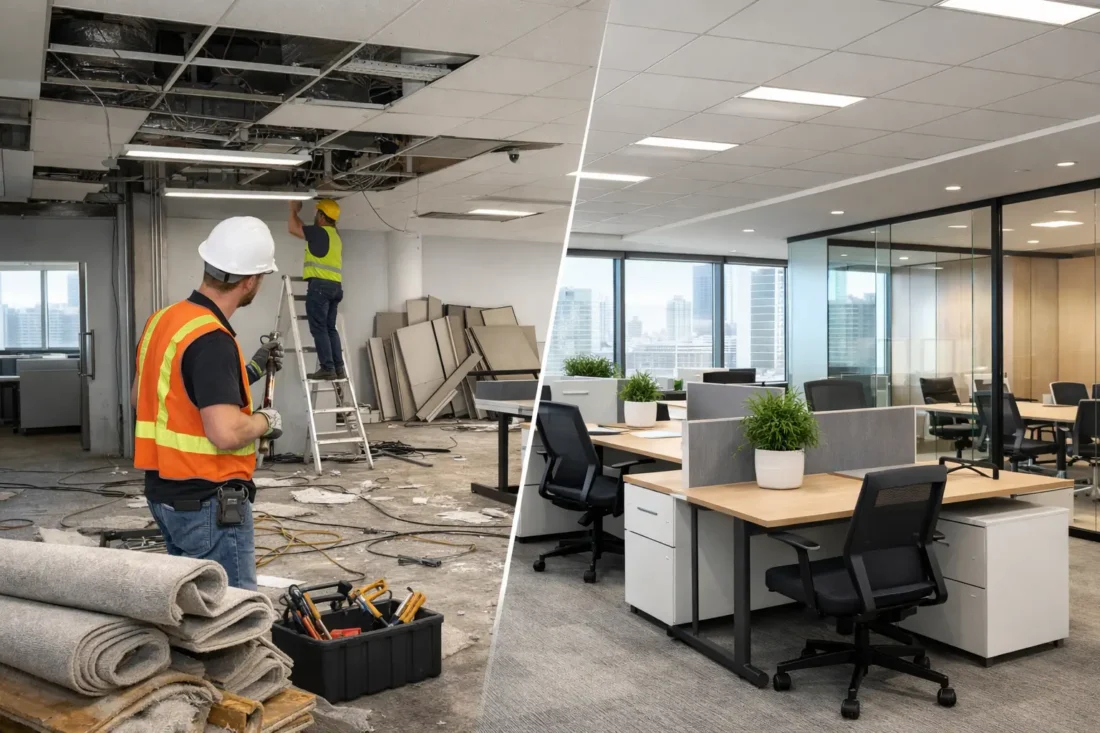
Office Reinstatement Services Singapore Explained
A lease expiry date can arrive quickly, but commercial reinstatement cannot be treated as a last-week task. Office reinstatement services Singapore tenants engage should do more than remove furniture and repaint walls. The work must return the unit to the condition stated in the tenancy agreement, satisfy building management requirements and leave enough time for landlord inspection, rectification and formal handover.
For an office manager, facilities team or business owner, the risk is not simply an untidy unit. Incomplete works can hold up the return of keys, delay the release of a security deposit or lead to additional charges. A properly managed reinstatement project controls those risks by assessing the required scope early and coordinating every trade under one clear programme.
What commercial reinstatement actually involves
Reinstatement is the process of removing tenant-installed additions and restoring a leased premises to its agreed original condition. That condition is not always identical to the bare unit seen on move-in day. It depends on the handover condition stated in the lease, any fit-out approvals, landlord correspondence and building management rules.
A typical office may have been altered over several years. Glass partitions may have created meeting rooms, new electrical circuits may serve workstations, and air-conditioning units may have been relocated to suit the layout. The final reinstatement scope needs to account for every approved alteration, not only the items that are immediately visible.
Common works include dismantling partitions, built-in joinery and raised flooring; removing signage, data cabling and loose furniture; restoring ceilings, lighting points and electrical wiring; removing or reinstating air-conditioning and plumbing works; patching walls and floors; painting; cleaning; and carting away debris. Retail, clinic, gym, food and industrial units often require additional specialist work because their fit-outs may include exhaust systems, water points, grease-related equipment, heavy-duty power supplies or custom fixtures.
The key point is that reinstatement is a coordinated technical exercise. Removing a partition, for example, may require ceiling repairs, floor patching, electrical termination, touch-up painting and disposal planning. Appointing separate parties for each task can create gaps in responsibility and make it difficult to resolve defects before inspection.
Why the tenancy agreement sets the scope
The lease and its reinstatement clause should be reviewed before any demolition or removal begins. It commonly specifies whether the unit must be returned to bare shell condition, whether existing landlord-provided fittings must remain, and whether reinstatement drawings or permits are required. Some landlords also issue a separate handover checklist nearer the end of the tenancy.
Photographs from the original handover, approved fit-out plans and records of subsequent alteration works are equally useful. They help distinguish between existing building elements and tenant additions. Where records are incomplete, a site survey and early discussion with the landlord or managing agent can prevent assumptions that later become costly variations.
It depends on the premises and lease terms, but these are the areas that most often need close checking:
- Partitions, doors, glass panels, cabinetry and feature finishes installed during fit-out.
- Electrical distribution boards, sockets, lighting, emergency systems and data or communication cabling.
- Air-conditioning, mechanical ventilation, plumbing, sanitary fittings and fire protection interfaces.
- Floor finishes, ceiling grids, wall surfaces, external signage and access-control equipment.
A contractor should identify the required approvals, building work hours, lift booking arrangements, protection requirements and disposal procedures before work starts. These details affect both programme and cost. In an occupied building, noisy dismantling may be restricted to evenings or weekends, while loading bay access can determine how quickly materials and debris can be moved.
Office reinstatement services Singapore tenants need at lease end
A full-scope contractor provides one point of accountability from survey through to handover. This matters when several trades must work in sequence. Electrical works cannot be safely finalised until affected fittings have been removed, and painting should follow patching rather than precede it. A single programme avoids the familiar problem of one contractor waiting for another while the handover deadline gets closer.
The project normally begins with a site assessment. The contractor reviews the premises, available drawings and landlord requirements, then prepares a scope that identifies demolition, restoration, disposal and finishing works. Any uncertainty should be raised at this stage, particularly where base-building systems, fire safety installations or concealed services may be affected.
Once the scope is agreed, the work should be planned around building management requirements. This can include submitting method statements, arranging insurance documentation, booking service lifts, protecting common areas and scheduling noisy work. For large offices or units with complex services, a phased approach may be sensible so the business can continue operating in part of the premises while the relocation is completed.
During execution, the contractor coordinates dismantling, trade reinstatement, waste removal and final cleaning. Debris should be removed through approved routes and disposed of properly, rather than left until the final day. A tidy site also makes it easier to identify defects such as exposed cables, damaged ceiling tiles or uneven floor patches before they become inspection issues.
The handover stage is where costly gaps appear
Completion of physical works is not always the end of the job. Landlords and managing agents may inspect the unit against their own checklist and request rectification before accepting the space. A handover-ready service includes a pre-inspection review, prompt attention to reasonable defects and support during the landlord inspection where required.
Common snags are usually small but consequential: an unused cable left above a ceiling, a mismatched paint patch, an opening in a raised floor, a missing ceiling tile or a disconnected service that has not been properly capped. These items are easier and less expensive to correct before the official handover than after contractors have demobilised.
Keep records throughout the project. Before-and-after photographs, site instructions, approval documents and completion records provide a clear trail if questions arise. They also help the tenant demonstrate that works were carried out in accordance with the agreed scope, rather than relying on verbal confirmation alone.
Cost and programme: what drives the price
Reinstatement pricing should reflect the actual condition and technical requirements of the unit. A straightforward open-plan office with limited tenant fit-out will cost less than a premises with extensive glass rooms, specialist electrical systems, plumbing alterations and restricted working hours. The cheapest quotation is not necessarily the lowest final cost if it excludes essential repairs, after-hours work, permits, waste disposal or handover rectification.
Ask for a clear scope rather than a single vague lump sum. The proposal should state what will be dismantled, what will be restored, how debris will be removed and what assumptions have been made. It should also identify exclusions. This makes quotations easier to compare and reduces the chance of disagreement once work is underway.
Programme pressure is another major cost factor. A tenant that begins planning months ahead can arrange surveys, approvals and work slots with greater flexibility. A tenant that waits until the lease end may need urgent labour, night works or weekend access, especially if the building limits daytime demolition. Early planning does not remove every surprise, but it gives the project enough time to resolve them without compromising quality.
Choosing a contractor for a compliant exit
The right contractor should understand commercial lease obligations as well as the practical work on site. Ask whether the team can cover the required trades, manage building submissions, coordinate disposal, provide a clear programme and assist with landlord inspection. Experience across offices, retail spaces and specialised commercial units is useful because no two handover requirements are exactly alike.
Office Reinstatement Singapore approaches the work as an end-to-end project, covering the trade coordination and final handover support that lease exits demand. The objective is straightforward: return the premises in the agreed condition, within the available timeframe, without leaving the tenant to chase multiple contractors.
The most useful next step is to review the reinstatement clause, gather the original fit-out records and arrange a site assessment well before your move-out date. A clear scope at the start gives your team the best chance of handing back the unit cleanly, compliantly and without an avoidable dispute.