


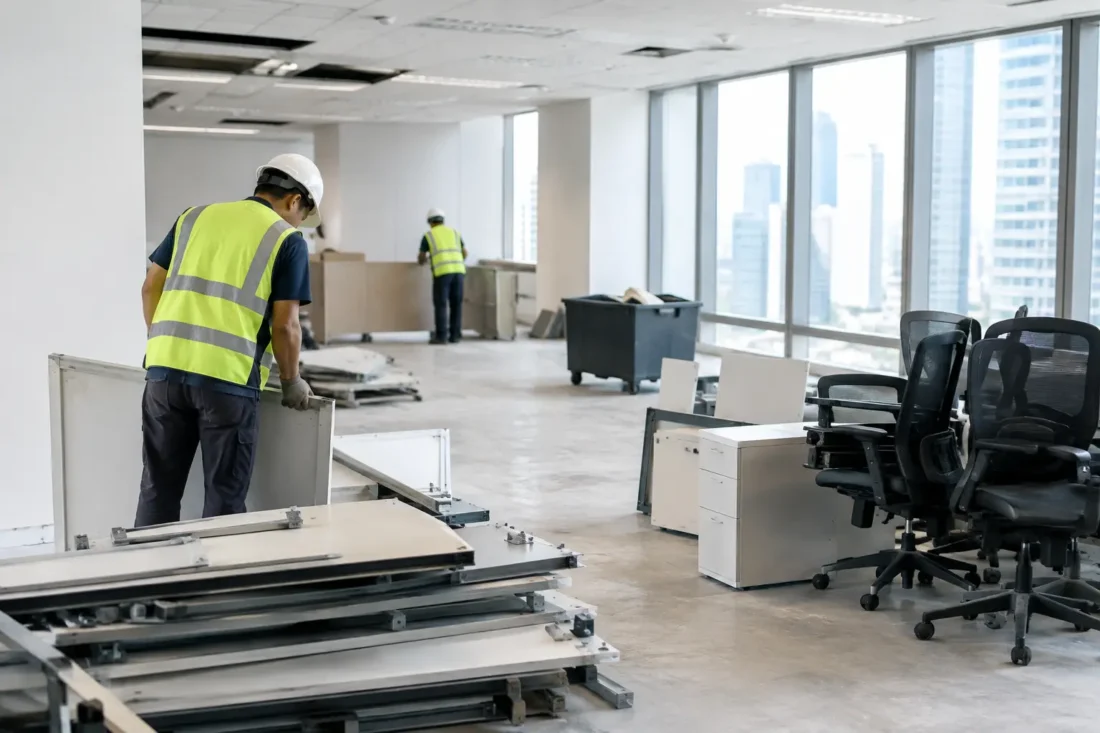
Office Dismantling Services for Lease Handover
A lease expiry date can arrive long before an office is ready to be returned. Custom partitions, data cabling, feature ceilings, built-in furniture and signage may have supported daily operations for years, but they can become handover liabilities once a tenant moves out. Professional office dismantling services remove these items safely and methodically while preparing the unit for reinstatement and landlord inspection.
For commercial tenants, dismantling is not simply a clearance exercise. The work must follow the tenancy agreement, approved reinstatement scope and building management rules. If one trade is left incomplete – such as exposed wiring, damaged flooring or an unsealed ceiling opening – the landlord may reject the handover or appoint another contractor at the tenant’s cost.
What Office Dismantling Services Should Cover
A properly managed dismantling project begins with an inspection of the existing fit-out and a review of the lease requirements. The objective is to identify what was installed by the tenant, what must remain, and what needs to be restored to the original base-building condition. This distinction matters. Removing landlord-owned equipment or finishes without approval can create unnecessary rectification costs.
The scope commonly includes dismantling non-structural partitions, glass panels, doors, built-in cabinetry, workstations, storage systems and loose furniture. It may also involve removing carpets, vinyl tiles, raised flooring finishes, false ceilings, light fittings, feature walls, wallpaper, blinds, window films, reception counters and tenant signage.
Technical items require equal attention. Electrical points, trunking, data cables, telephone lines, plumbing fixtures, air-conditioning equipment and ventilation ducting often need to be disconnected, removed or restored by qualified personnel. In Singapore, building management may also require permits, work schedules, lift protection, debris disposal arrangements and testing before works can proceed.
The correct scope depends on the condition stated in the lease and any approved alteration drawings. A unit handed over as a bare shell will require more extensive removal than one originally delivered with ceilings, lighting and floor finishes. A reliable contractor clarifies these requirements before work starts rather than making assumptions during the final week of the tenancy.
Why Dismantling and Reinstatement Must Be Planned Together
Some tenants engage a mover to remove furniture, then arrange separate demolition, electrical, painting and cleaning contractors. This can appear cheaper at the outset, but it creates gaps in responsibility. When a damaged wall, unfinished cable point or missing ceiling tile is identified at inspection, each party may claim the issue falls outside its scope.
An end-to-end contractor manages dismantling as the first stage of reinstatement. Materials are removed in the right order, exposed services are made safe, and surfaces are restored as work progresses. This reduces repeat visits, avoids accidental damage to retained finishes and gives the tenant one accountable point of contact.
For example, removing a partition may leave screw holes in the floor, ceiling and adjoining walls. The job is not complete when the partition is taken down. The affected areas must be patched, levelled, painted or matched to the required finish. Likewise, removing a pantry may involve electrical isolation, plumbing capping, tile repairs, waterproofing checks and disposal of bulky waste. These are linked tasks, not separate afterthoughts.
Key Checks Before Work Begins
Before appointing a contractor, confirm the handover standard in the tenancy agreement and obtain any landlord or managing agent requirements in writing. If the unit has been altered more than once, older renovation records and photographs can be useful in establishing the original condition.
A site survey should assess access routes, loading bay restrictions, lift sizes, working hours and the presence of other occupants in the building. These practical details affect programme duration and cost. A large desk system may need to be dismantled in place because it cannot be moved through the lift. Glass partitions may require protected removal and careful handling to prevent damage to common areas.
The contractor should also identify items suitable for retention, relocation or responsible disposal. Reusable furniture can be moved to a new office, while selected materials may be salvaged where appropriate. However, reuse should not delay the reinstatement programme or compromise the agreed handover condition.
A clear proposal should state what is included, what is excluded and which reinstatement works follow dismantling. This is particularly important for concealed conditions. Once ceilings, flooring or joinery are opened up, previous works may reveal damaged substrates, redundant services or non-compliant alterations that need additional rectification.
A Controlled Dismantling Process
A disciplined process protects the premises and keeps the project on schedule. While every site differs, an effective programme normally follows these stages:
- Review the lease, approved scope, site condition and building management procedures.
- Isolate relevant electrical, plumbing, data and mechanical services before removal.
- Dismantle furniture, partitions, ceilings, flooring and other tenant-installed finishes in a planned sequence.
- Remove debris through approved routes and arrange lawful disposal.
- Reinstate affected walls, floors, ceilings and services, followed by painting and detailed cleaning.
- Conduct a pre-handover inspection and address outstanding defects before the landlord’s final inspection.
The sequence is not fixed for every unit. In an occupied office, furniture and IT equipment may need to be removed first to allow safe access. In a retail or food and beverage space, specialist equipment and service disconnections may take priority. The principle remains the same: control the work from isolation through to restoration, rather than treating removal as a standalone task.
Common Risks That Cause Handover Delays
The most frequent delays are usually avoidable. Tenants often underestimate the time required for building approvals, especially where after-hours work, hoarding, lift bookings or disposal arrangements are required. Starting only a few days before the lease ends leaves little room to correct defects.
Another common issue is incomplete removal. Concealed cabling above ceiling level, unused trunking, signage fixings, adhesive residue and old pipework are easily missed during a rushed strip-out. Landlords may also reject poorly repaired surfaces where colour matching, patching or ceiling grid alignment is visibly inconsistent.
Cost disputes can arise when the scope has not been properly defined. A low quotation that covers demolition alone may exclude electrical reinstatement, air-conditioning works, debris disposal, painting, cleaning and defect rectification. Comparing quotations line by line is more useful than comparing a single headline figure.
There is also a compliance risk. Unauthorised electrical disconnection, improper waste handling or damage to common property can lead to charges from building management. The cheapest option is rarely the most affordable if it results in penalties, extension rent or a delayed security deposit release.
Choosing a Contractor for the Full Scope
The right contractor should be able to explain the condition the unit needs to meet, not merely list items to be removed. Ask how the team will protect lifts and common areas, coordinate with management, isolate services, dispose of debris and manage defects found at inspection.
Trade coverage matters because lease-end projects often involve several systems at once. A contractor that coordinates partition removal, flooring and ceiling repairs, electrical and plumbing reinstatement, HVAC works, painting and cleaning can maintain a single programme and reduce handover risk. This is especially valuable when the move-out date is fixed and business operations are already focused on relocation.
Office Reinstatement Singapore approaches dismantling as part of a complete handover-ready reinstatement scope. The work is planned around lease obligations, building requirements and the practical need to return the premises without unnecessary delay or avoidable rectification costs.
Prepare Earlier Than You Think
Begin the review of your lease and premises condition well before the final month of occupancy. Early planning provides time to clarify ambiguities with the landlord, obtain building approvals and schedule works around your move. It also allows a contractor to identify the full extent of office dismantling services required before the site is emptied.
A clean, compliant handover is easier to achieve when dismantling, repairs and final inspection are treated as one coordinated project. Put the scope in writing, allow time for defects, and appoint a team that remains accountable until the unit is ready for return.