


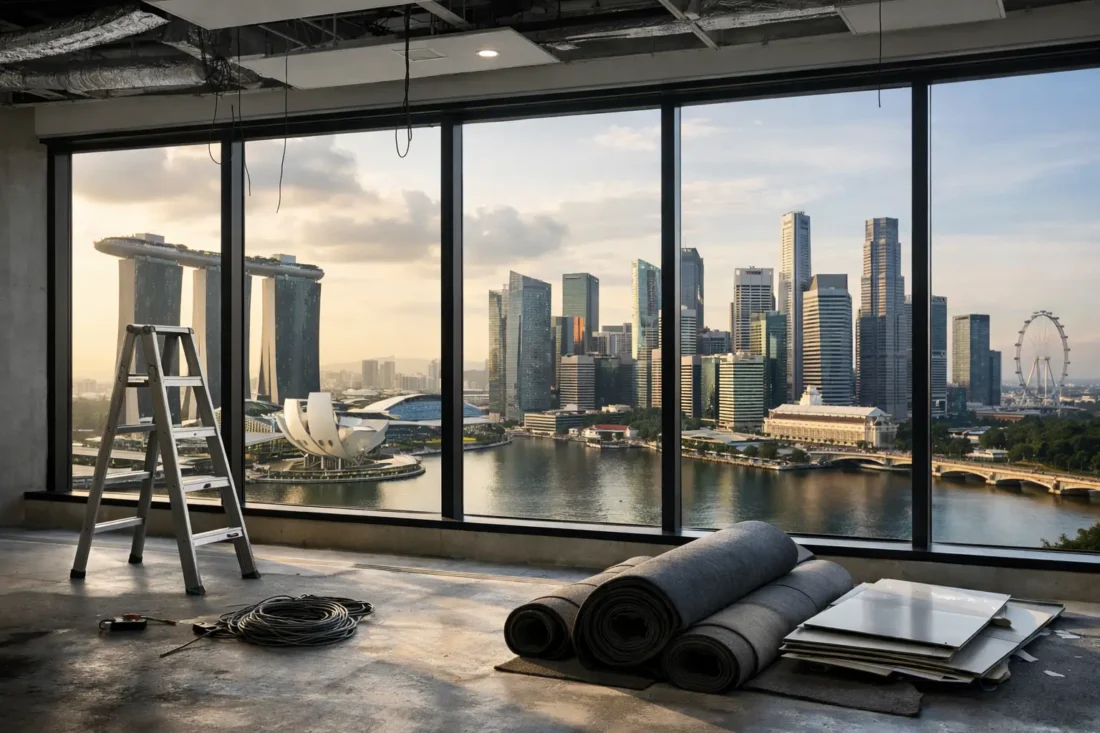
Office Reinstatement Cost Singapore 2026
A lease expiry rarely becomes stressful because of one big issue. It is usually the smaller items that cause trouble – missing ceiling tiles, exposed wiring, unauthorised partitions, damaged flooring, incomplete removals, or a landlord insisting the unit go back to base condition. That is why understanding office reinstatement cost Singapore 2026 guide + cost per sq ft matters early, not in the final week before handover.
For most offices in Singapore, reinstatement cost is commonly priced from around $3 to $12 per sq ft, but that range only makes sense when you know what is actually being removed, restored, patched, repainted and cleared. A fitted office with meeting rooms, carpet tiles, lighting changes and data cabling will not be priced like a near-bare unit. If your unit includes pantry plumbing, glass partitions, raised flooring or extra air-conditioning works, the rate can move well above the lower end quickly.
Office reinstatement cost Singapore 2026 guide + cost per sq ft
The most practical way to budget is to treat cost per sq ft as a starting benchmark, not a final quote. In 2026, a small office with basic reinstatement scope may fall between $3 and $5 per sq ft. A standard fitted office with partitions, flooring, electrical points, painting and disposal often lands around $5 to $8 per sq ft. Heavier reinstatement involving mechanical and electrical removal, ceiling repairs, plumbing capping, hacking or strict building requirements can reach $8 to $12 per sq ft or more.
That range reflects real project conditions. Contractors are not simply charging for floor area. They are pricing labour, access restrictions, dismantling complexity, debris handling, reinstatement materials, testing where required, and the administrative work needed for approvals, work permits and handover coordination.
A 2,000 sq ft office therefore might cost around $10,000 at the lower-middle range, but the same size unit could exceed $20,000 if the fit-out is dense or the landlord requires extensive restoration. Size affects pricing, but scope drives it.
Typical 2026 cost bands by office condition
A lightly fitted unit with minimal alterations is usually the most economical. If the space only needs loose furniture removal, carpet removal, repainting, minor ceiling patching and general making good, rates tend to stay near the lower end.
A more typical corporate office sits in the middle. This usually includes dismantling partitions, removing built-in joinery, reinstating electrical points, taking out data cabling, patching walls, replacing ceiling boards, removing floor finishes and carrying out final cleaning.
The highest band usually applies where there are pantry areas, server rooms, custom lighting, additional air-conditioning units, wet works or landlord-mandated restoration to original M&E layouts. Buildings with tight after-hours working windows can also push pricing up because labour becomes less efficient.
What pushes reinstatement cost up or down
The first major pricing factor is original fit-out density. The more the office was altered during tenancy, the more there is to reverse. Glass rooms, gypsum partitions, feature ceilings, platform floors and custom reception counters all add dismantling and making-good work.
The second factor is building management requirements. Some buildings allow efficient loading access and straightforward disposal arrangements. Others require deposits, permit submissions, restricted working hours, noise controls, protected lift usage and additional supervision. These do not always appear dramatic on paper, but they affect manpower planning and project duration.
The third factor is whether the landlord wants reinstatement to bare shell, partial reinstatement, or simply good tenantable condition. These are not the same thing. A tenant who assumes repainting and carpet removal are enough may later find the landlord also expects electrical rewiring removal, fire protection reinstatement or return of the original ceiling grid layout.
The fourth factor is hidden damage uncovered during dismantling. Once partitions, vinyl, carpet or cabinets are removed, contractors may find broken screed, stained slab surfaces, unapproved wiring routes or wall damage that needs additional repair. This is one reason experienced contractors avoid over-promising low rates before site inspection.
Why cost per sq ft can mislead without scope
Cost per sq ft is useful for early budgeting, but it is not a substitute for a proper breakdown. Two offices of the same size can have very different reinstatement values. One may be open-plan with loose furniture only. The other may have six meeting rooms, a pantry, manager cabins, signboards, access control devices, wall finishes and rerouted air-conditioning.
If you compare quotations only by floor area, you can end up accepting a cheaper number that excludes key items. The issue usually appears at the end, when variation charges start arriving for disposal, ceiling repairs, electrical termination, permit handling or final touch-up works that should have been priced from the start.
What is usually included in a reinstatement quotation
A proper office reinstatement quotation should clearly describe the dismantling scope, restoration scope and handover support. This often includes partition dismantling, flooring removal, ceiling making good, electrical point removal or reversion, plumbing capping where needed, painting, debris disposal and final cleaning.
Where applicable, it should also address signage removal, furniture dismantling, data cable removal, air-conditioning dismantling, light fitting removal, smoke detector relocation support and patching of affected wall and ceiling finishes. If the landlord or building management has a reinstatement manual, the contractor should align the scope to that document instead of relying on assumptions.
This is where a full-scope contractor adds value. Office Reinstatement Singapore, for example, positions reinstatement as an end-to-end handover process rather than a collection of isolated trades. That matters because lease-end risk usually comes from coordination gaps, not just physical work.
Some quotations look competitive because key items are left out. Permit fees, deposits, after-hours labour, haulage, hacking, disposal by volume, additional ceiling tile replacement and air-conditioning works are common examples. Electrical testing, fire alarm interface works and waterproofing repairs may also sit outside a basic quote.
Another frequent issue is provisional sums. These are not necessarily unreasonable, especially when concealed conditions are unknown, but they should be identified clearly. If too much of the quote is provisional, your final spend may end up far above the original number.
Ask one practical question before comparing any two quotes: does this price cover the full handover condition expected by the landlord? If the answer is vague, the quote is not complete enough for decision-making.
How to budget realistically in 2026
Start with your tenancy agreement, original handover condition if available, and any fit-out approval drawings. Those three documents often tell you more about likely cost than floor area alone. Then arrange a site assessment so the contractor can identify what was added during occupancy and what must be removed or restored.
If you need an internal budgeting rule, use a middle-range allowance first rather than the lowest market figure. For many standard fitted offices, planning around $5 to $8 per sq ft gives a more realistic starting point than assuming a stripped-back rate. If your office has pantry works, heavy M&E modifications or premium finishes, build in extra contingency.
A contingency of 10 to 15 per cent is sensible where original unit information is incomplete or where dismantling may reveal hidden defects. That buffer is often the difference between a controlled close-out and a last-minute budget problem.
How to keep costs under control without risking compliance
The best way to reduce reinstatement cost is to reduce uncertainty. Engage the contractor early, confirm landlord expectations in writing, and align the scope before work starts. Late clarification almost always costs more because it leads to rushed variations, rework or missed items.
It also helps to avoid splitting the project across too many separate vendors. A cheaper demolition crew may not be cheaper if you then need another contractor for electrical making good, another for painting, and another for final defect rectification. Single-point accountability usually produces fewer disputes and a cleaner handover.
Timing matters as well. If you wait until the final days of your lease, you may be forced into premium scheduling, night works or incomplete rectification under pressure. Starting earlier gives you room for survey, approval submission, execution and landlord inspection.
Choosing a contractor for office reinstatement cost Singapore work
Price matters, but clarity matters more. A reliable contractor should be able to explain exactly what is included, what assumptions were made, what approvals are needed, how disposal will be handled and what support is provided during final inspection.
They should also be comfortable reviewing tenancy clauses and building requirements, because reinstatement is not only a construction job. It is a compliance and handover job. The right contractor helps you avoid penalties, delays and preventable disputes by getting the condition right the first time.
If you are budgeting for lease-end works in 2026, treat cost per sq ft as the start of the conversation, not the decision itself. The cheapest figure on paper is rarely the cheapest route to a clean handover.