


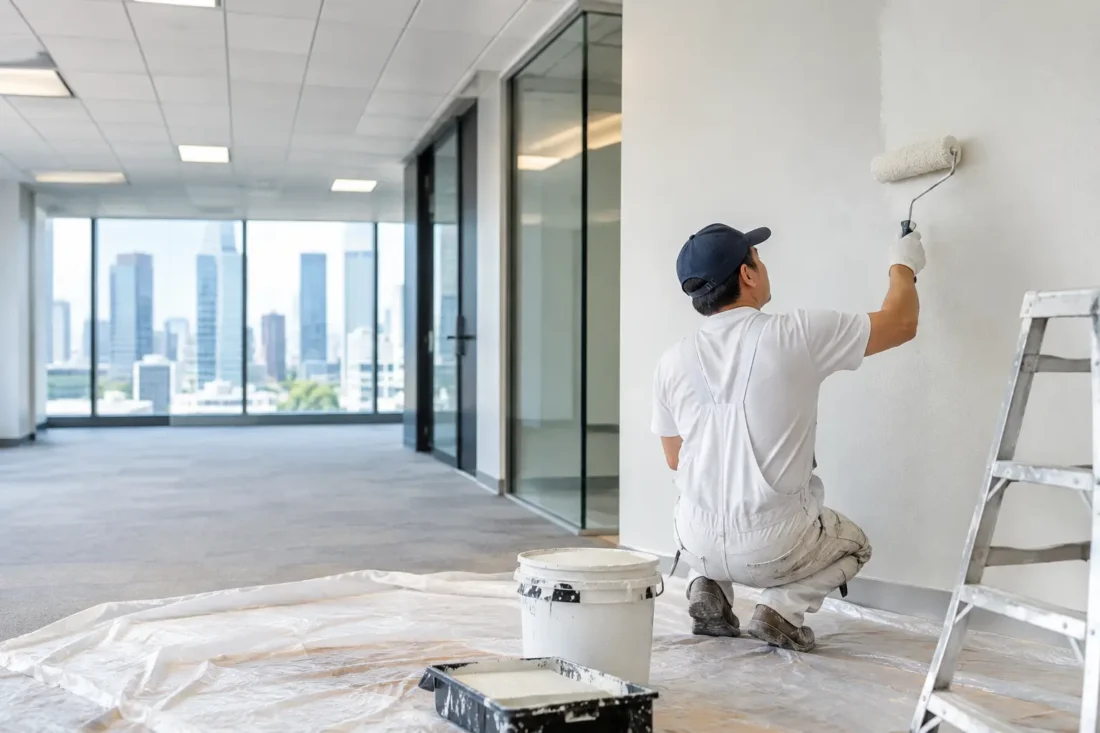
Office Interior Painting for Lease Handover
A tired feature wall, unfilled screw holes and paint that no longer matches the original finish can turn an otherwise complete handover into a landlord rejection. Office interior painting is often treated as a final cosmetic task, but at lease end it is a key part of commercial reinstatement. The work must restore the premises to the condition required by the tenancy agreement, building management and landlord inspection – not simply make the office look presentable.
For businesses vacating commercial premises, the right painting scope protects against rectification requests, delayed deposit release and avoidable disruption to moving plans. It also needs to be coordinated with partition removal, electrical works, ceiling repairs and final cleaning so that completed surfaces are not damaged by later trades.
When office interior painting is required
The tenancy agreement and the approved condition of the unit should determine the scope. Many commercial leases require tenants to return the space in its original layout and condition, fair wear and tear aside. If a tenant has installed branded colours, murals, feature walls, new partitions or signage, painting is normally required after those items are removed.
The practical question is not whether a wall appears clean enough for the next occupier. It is whether it matches the reinstatement requirement. Landlords may require all internal walls to be returned to a specified neutral colour, while others may accept localised repairs where the original finish is retained. Building management may also impose rules on working hours, lift bookings, material deliveries and the disposal of paint-related waste.
Before work starts, review the tenancy agreement, reinstatement clause, original handover records and any landlord-issued specifications. A site inspection should identify altered areas and distinguish them from existing defects. This prevents a departing tenant from being held responsible for damage that was already present at the start of the lease.
Office interior painting is more than a fresh coat
A compliant finish depends on preparation. Painting directly over adhesive marks, joint compound, cracked plaster or greasy surfaces may look acceptable for a short period, but defects can become obvious under inspection lighting. More importantly, rushed work can leave visible patches that fail to blend with surrounding areas.
A proper commercial painting scope typically begins with protecting retained floors, doors, glazing and fixtures. Contractors then remove loose coatings, scrape away residue from decals or cable trunking, fill holes and cracks, sand repaired areas, and apply primer where needed. Only then should the selected topcoat be applied to achieve an even finish.
The required coating system depends on the substrate and the condition of the surface. Plasterboard partitions, concrete walls, timber skirtings, metal frames and ceilings do not always need the same preparation or paint. Water stains and nicotine marks, for example, may need a stain-blocking primer before repainting. Areas affected by water leaks should not be painted over until the source of moisture has been resolved, otherwise staining and peeling may return after handover.
Colour matching also deserves attention. If the landlord requires an existing colour to be retained, a paint sample or approved colour reference should be used. Assuming that standard white will match an aged off-white wall often produces obvious variation. Where patch repairs cannot be blended convincingly, repainting the entire wall or room may be the more economical choice because it reduces the risk of repeat work.
Coordinate painting with other reinstatement works
Painting should be scheduled late in the reinstatement programme, but not automatically as the final activity. The correct sequence depends on the scope of the unit.
Partition dismantling, false ceiling removal, signage removal and electrical point reinstatement commonly expose holes, uneven paint lines and damaged surfaces. These activities should be completed first. Any wall repair, skim coating or ceiling patching then needs enough drying time before paint is applied. Painting too early means freshly coated surfaces can be marked by electricians, air-conditioning technicians or furniture removal crews.
Final cleaning should follow the completion of dusty preparation and most painting work. However, a last touch-up may still be needed after cleaning, especially around door frames, service risers and high-traffic access routes. The contractor should inspect the space before handover rather than relying solely on the painters’ completion check.
For occupied offices, phasing can reduce downtime. Painting can be carried out by room, floor zone or after-hours work schedule where building rules permit. This approach is useful when a business must keep certain teams operating until the final relocation date. It does require careful access planning, ventilation management and protection of equipment, so it is not always the cheapest option.
Choosing the right finish for a commercial unit
A landlord’s specification takes priority over personal preference. If no exact paint brand or finish is stated, a neutral, professional finish is generally the safest choice for reinstatement. Low-sheen or matt coatings are often used on internal walls because they reduce glare and hide small surface irregularities better than gloss finishes.
Durability matters in corridors, reception areas and spaces exposed to frequent contact. A washable coating may be appropriate if the landlord permits it, but using a significantly different sheen from the surrounding area can create a mismatch. In wet pantries, washrooms or areas with recurring humidity, the finish must also be suitable for the environment. Paint is not a substitute for repairing failed waterproofing, leaking pipes or inadequate ventilation.
Do not overlook ceilings, skirtings, door frames and service enclosures. These areas are frequently missed when teams focus only on wall surfaces, yet they can show drilling marks, old signage outlines or discolouration. A detailed room-by-room scope is more reliable than a broad instruction to “repaint the office”.
Common handover issues that lead to repainting
Landlord inspections tend to identify defects at transitions: the line left after a removed partition, an unpainted strip behind a cabinet, exposed screw holes around signage, or a newly patched area that is visibly darker than the wall around it. These are small issues, but they signal incomplete reinstatement.
Other common problems include paint splashes on carpet tiles or glazing, poor cut-in lines at ceiling edges, roller marks, uneven coverage and failure to remove tape or surface protection. In units with previous fit-outs, adhesive residue from vinyl graphics and nameplates can be particularly difficult. It may require controlled scraping and surface repair before painting rather than repeated coats intended to hide the texture.
A handover-ready inspection should check the following areas together: wall and ceiling finish, repairs after removals, condition of frames and skirtings, cleanliness of painted surfaces, and consistency of colour and sheen. Checking these items before the landlord’s inspection gives the project team time to rectify defects without extending the move-out date.
Managing cost without risking compliance
The lowest painting quotation may exclude essential preparation, access equipment, protection works, patch repairs, off-hours labour or touch-up after other trades finish. Comparing quotations only by square footage can therefore be misleading. A clear scope should state which rooms and surfaces are included, how defects will be repaired, the proposed paint system, number of coats, protection measures and whether final defects rectification is covered.
The cheapest approach is not always full repainting, either. If the original finish remains in good condition and the lease allows it, targeted repairs may be sufficient. Conversely, patching several altered walls can become more expensive and less reliable than repainting a defined area in full. The right decision depends on the landlord’s standard, the surface condition and how closely the new paint can match.
Engaging one contractor to coordinate painting with dismantling, M&E reinstatement, ceiling and flooring repairs reduces the risk of duplicated site visits and conflicting work sequences. For lease-end projects, Office Reinstatement Singapore can manage these trades under one reinstatement programme, with the aim of presenting a clean, compliant unit for landlord handover.
A freshly painted office should not merely look vacant. It should show that every removed fitting, altered surface and affected finish has been properly returned to the agreed condition – giving the landlord fewer reasons to delay acceptance.