


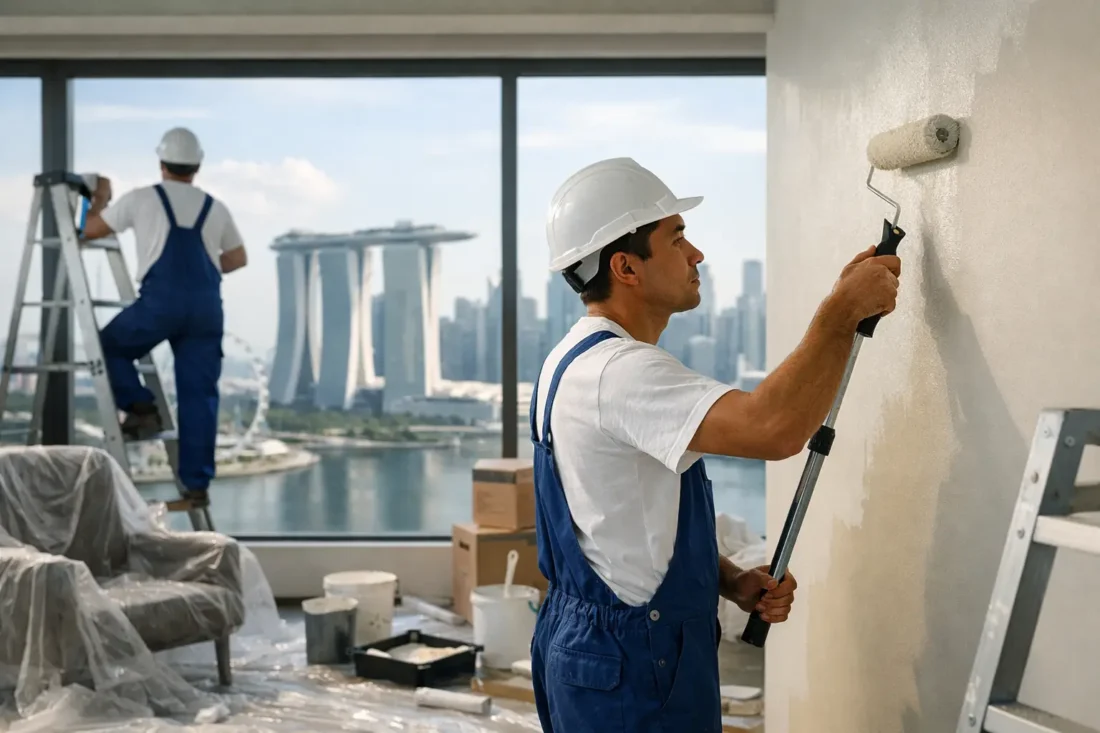
Commercial Painting Services Singapore Guide
A landlord walkthrough rarely fails because of one major defect. More often, it is the small visible issues that create friction – patched walls in the wrong shade, uneven touch-ups, paint on skirting, or old signage marks still showing through. That is why commercial painting services Singapore businesses engage should be treated as part of handover planning, not a last-minute cosmetic job.
For offices, shops, clinics and other leased premises, painting is often tied directly to reinstatement obligations. It is not only about making a unit look clean again. It is about restoring the space to an acceptable condition, matching tenancy requirements, and avoiding arguments during final inspection. If the paintwork is incomplete, inconsistent or clearly rushed, it can undermine the rest of the reinstatement even when other works have been done properly.
When commercial painting services in Singapore are actually needed
Many tenants assume repainting is only necessary when walls are badly damaged. In practice, painting is commonly required whenever there have been alterations, partition removals, signage installations, heavy operational use or brand-specific colour schemes. A unit that has been occupied for several years will often show wear around entrances, reception areas, meeting rooms, pantry spaces and service corridors.
Lease-end situations are the clearest case. If your original unit was handed over in a neutral finish and you later introduced feature walls, decals, dark colours or custom fit-out elements, there is a strong chance repainting will be needed to return the premises to an acceptable base condition. This applies across offices, retail units, F&B spaces, gyms and medical suites, although the extent of work varies.
It also depends on what the landlord and building management expect. Some properties require full repainting for reinstated areas. Others may accept localised patching if the finish is consistent and the original look is properly restored. The key point is that painting decisions should be based on actual handover obligations, not guesswork.
Painting is not separate from reinstatement
This is where commercial tenants often lose time and money. They appoint one contractor for dismantling, another for flooring, a third for electrical works, and only then bring in painters to cover the visible damage. That sequence sounds manageable until each trade leaves behind minor defects for the next one to deal with.
In a proper reinstatement workflow, painting comes after substrate repairs, partition removal, ceiling rectification, electrical point removal and other making-good works. Otherwise, fresh paint may have to be redone after hacking, patching or cable removal. The result is duplicated cost and avoidable delay.
For lease-end projects, painting should be planned as part of the full scope. If a wall is being reinstated, the final finish matters just as much as the structural correction. If signage has been removed, surface treatment and repainting are part of the same issue. If built-in furniture leaves exposed marks, painting is not optional finishing work – it is necessary restoration.
What a proper commercial painting scope should cover
A commercial paint job should begin with surface assessment, not colour selection. The contractor needs to check for nail holes, anchor points, adhesive residue, hairline cracks, water stains, uneven plaster patches and substrate damage from previous fit-out works. Painting over these defects without proper preparation creates a poor finish and can raise questions during inspection.
Preparation usually includes scraping loose material, patching damaged areas, sanding uneven surfaces and protecting floors, doors, glass panels and fixtures. In some units, stain blocking or sealer coats may also be needed, especially where there were old leaks, grease exposure or dark branded colours.
The painting itself must match the reinstatement objective. Sometimes that means restoring walls and ceilings to a neutral landlord-approved finish. In other cases, it means repainting only the affected areas so the space looks uniform. The right approach depends on the condition of the unit, the visibility of the repaired sections and the acceptance standard expected at handover.
A competent contractor should also clarify whether the scope includes ceilings, columns, door frames, service riser doors, skirting, internal partitions and exposed utility areas. Disputes often happen because the tenant assumed these elements were included while the contractor priced only basic wall surfaces.
Why colour matching and finish consistency matter
On active commercial sites, tenants sometimes ask for spot painting to save money. That can work, but only when the existing paint condition is stable and the repaired area is limited. If the original surface has faded, accumulated stains or changed tone over time, patch painting may stand out more than expected.
This is especially relevant under strong office lighting or in retail units with glass frontage. A repaint that looks acceptable from one angle can show visible flashing, roller marks or shade differences from another. In those cases, a broader repaint across the full wall plane is often the more cost-effective choice because it avoids rework and handover objections.
Finish consistency matters just as much as colour. If one section is matt and another has a low sheen, repaired areas will remain visible. Commercial painting is judged less by the can specification and more by the final uniformity of the surface.
Choosing commercial painting services Singapore businesses can rely on
The best commercial painting services Singapore tenants choose are not simply the cheapest per square foot. The right contractor understands programme pressure, access rules, reinstatement sequencing and inspection risk. That matters far more than headline pricing when a lease expiry date is fixed.
A good starting point is scope clarity. The contractor should be able to explain what is included, what substrate repairs are assumed, how many coats are planned, what protection measures will be used and whether touch-ups after other trades are covered. If these basics are vague, problems usually appear on site.
You should also look for experience in occupied buildings and managed commercial developments. Painting in a business environment often involves permit timing, loading restrictions, after-hours work, lift protection rules and debris control. A residential-style approach does not translate well to office towers, malls or industrial facilities.
Most importantly, the painter should understand the difference between decorative upgrading and lease-end reinstatement. Those are not the same job. Reinstatement painting is measured against compliance, restoration and acceptance. If the contractor does not ask for your tenancy requirements, approved drawings or landlord expectations, they may be treating the work too casually.
Timing the works properly
Painting is usually one of the last visible trades, but it should not be one of the last decisions. Once you know your move-out schedule, painting scope should be reviewed alongside dismantling, M&E removals and making-good works. That allows realistic sequencing and prevents the common mistake of leaving insufficient drying and touch-up time before inspection.
In Singapore, many commercial sites have restricted working hours or require advance approval for noisy works and material delivery. That affects project planning. A contractor who manages painting as part of a larger reinstatement programme can coordinate these constraints more efficiently than separate vendors working in isolation.
There is also the question of handover condition. If cleaners enter too early, dust from later works will settle on fresh finishes. If painters enter too early, repaired areas may still be damp or unfinished. The process has to be managed as a whole.
One contractor or multiple vendors?
If you only need repainting in an otherwise intact unit, a standalone painting contractor may be enough. But if your premises also require partition dismantling, ceiling repairs, flooring removal, electrical disconnection, signage removal and final cleaning, splitting the scope across multiple vendors increases coordination risk.
That is why many tenants prefer a reinstatement contractor that includes painting within a full handover package. It reduces interface issues, shortens communication lines and makes accountability clearer. When one party controls the sequence, it is easier to avoid blame-shifting between trades.
For businesses facing lease-end deadlines, that practical advantage often matters more than minor price differences. Office Reinstatement Singapore operates in that model – painting is handled as part of a wider reinstatement process so the unit is restored in a coordinated, inspection-ready way.
What to prepare before getting a quotation
Before requesting pricing, gather your tenancy agreement, any reinstatement clauses, approved fit-out drawings if available, and photos of current unit condition. It also helps to flag any dark feature walls, removed built-ins, old signage positions or landlord comments from earlier inspections. The more accurately the contractor can assess the reinstatement painting scope, the fewer surprises you will face later.
A site visit is usually the most reliable basis for quotation. Paint quantities alone do not determine cost. Access conditions, protection needs, patching extent, working hours and programme constraints can significantly affect the job.
If your lease is ending soon, do not wait for dismantling to begin before checking the paintwork requirement. By then, time is usually tighter, defects are more visible and options are fewer.
The right paint finish does more than improve appearance. It closes out the visible evidence of occupancy and helps your unit look properly returned, not partially vacated. When handover is on the line, that difference is worth planning for early.