


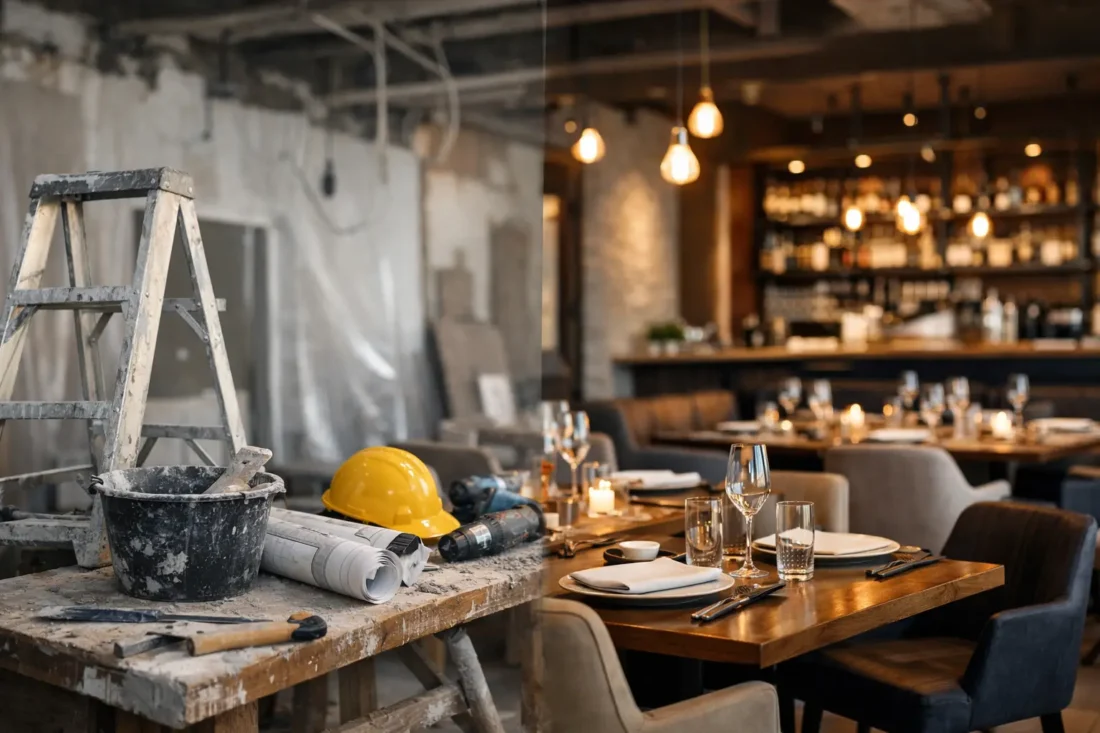
Restaurant Renovation Before Lease Handover
A restaurant unit rarely goes back to the landlord in the same condition it was first handed over. Years of fit-out changes, kitchen upgrades, grease management works, extra plumbing runs and branding installations all add up. When restaurant renovation is followed by lease expiry, the real issue is no longer design or trading appeal – it is whether the premises can be restored properly, on time and in line with tenancy requirements.
For restaurant operators, that distinction matters. A renovation project is usually judged by customer experience and operational efficiency. A reinstatement project is judged by lease compliance, building management approval, workmanship and handover acceptance. If those lines get blurred, the result is often avoidable cost, disputes over scope and last-minute pressure when the landlord inspection is due.
How restaurant renovation creates handover risk
Most restaurant spaces undergo heavier alteration than standard retail units. Exhaust ducting, grease traps, floor traps, kitchen partitions, cold room installations, gas lines, upgraded electrical loading and water supply modifications are common. Front-of-house areas are also heavily customised, with decorative ceilings, feature lighting, counters, signage and bespoke flooring.
That is why restaurant renovation tends to create a deeper reinstatement burden at the end of the lease. The more extensive the fit-out, the more likely it is that ceilings have been cut, floors chased, services rerouted and structural interfaces changed. Landlords and building management teams will usually look beyond surface finishes. They want to know whether unauthorised additions have been removed, exposed areas restored and core systems returned to the required condition.
The practical issue is that many operators underestimate the amount of hidden work involved. Removing a display counter is simple enough. Restoring damaged floor finishes beneath it, capping plumbing points correctly, making safe electrical terminations and repairing wall finishes to an acceptable standard is where time and cost start to move.
Restaurant renovation vs reinstatement
A restaurant renovation improves the space for trading. Reinstatement removes those improvements where required and returns the premises to its original or landlord-specified condition. They are not opposites in theory, but they are very different in execution.
Renovation work allows a degree of creativity and operational tailoring. Reinstatement is controlled by documents, approvals and the condition expected at handover. In some cases, the landlord may permit selected installations to remain. In others, full removal is mandatory even if the fixtures are still in good condition. It depends on the lease, the original handover state and any approved fit-out submissions made during occupancy.
This is where commercially practical planning makes a difference. Before any dismantling starts, the scope should be tied back to the tenancy agreement, fit-out drawings if available, and current site conditions. Without that review, businesses can either remove more than necessary or leave behind items that trigger rejection during final inspection.
What usually needs attention after a restaurant renovation
Restaurants have a wider technical scope than many commercial units, so reinstatement normally cuts across multiple trades. The front-of-house may involve partition demolition, signage removal, painting, flooring repairs, ceiling patching and lighting removal. The back-of-house is usually more involved, especially where there is a working kitchen.
Kitchen extraction systems often need dismantling, including hoods, ducting, supports and associated electrical isolation. Grease management components may need removal or proper decommissioning, depending on landlord instructions and building requirements. Plumbing lines for sinks, prep areas and dishwashing stations frequently need to be capped, tested and made safe. Floor traps and drainage points may need treatment if they were added during tenancy.
Electrical work is another area where assumptions cause problems. Restaurants often install additional distribution boards, dedicated circuits, heavy-duty cabling and extra lighting. These cannot simply be disconnected and left in place. They must be isolated, removed or reinstated according to building standards, with the surrounding finishes restored.
Air-conditioning works can also become contentious. Some tenants add FCUs, reroute drainage, or alter diffusers to suit kitchen and dining layouts. If the original configuration has changed, reinstatement may involve removal, reinstatement of ceiling areas and coordination with building management procedures.
Why documentation matters more than most tenants expect
In restaurant handovers, paperwork can be as important as physical work. If the landlord or managing agent asks what was added, approved or altered during the tenancy, vague answers are not helpful. Drawings, approval records, inventory photos and the original handover condition all help define the reinstatement scope.
Where documents are incomplete, a site assessment becomes even more important. A contractor needs to identify what appears original, what was added later and what interfaces may affect common services or neighbouring units. This is especially relevant in malls, mixed-use developments and strata properties in Singapore, where building management rules can be strict and access windows limited.
A well-documented reinstatement scope reduces three common problems. First, it prevents under-scoping, where key removals are discovered too late. Second, it helps control cost variation by clarifying what is included from the outset. Third, it gives the tenant a stronger basis when discussing expectations with the landlord before final handover.
Timing a restaurant renovation exit properly
Many restaurant operators leave reinstatement too late because trading operations take priority until the final weeks. That is understandable, but it increases risk. Restaurant units often need more dismantling, more debris handling and more repair work than a standard office or boutique shop. If approvals, service shutdowns or night works are involved, the schedule tightens quickly.
The better approach is to treat lease-end planning as a separate project, not an afterthought to closure. Once non-renewal is likely, the site should be reviewed early. This allows time to confirm landlord requirements, arrange access, sequence dismantling safely and avoid premium charges for rushed work.
There is also a cost trade-off to consider. Starting too early can disrupt remaining operations. Starting too late can result in extension charges, deposit deductions or emergency mobilisation fees. The right timing depends on unit size, kitchen complexity, mall restrictions and whether selective salvage is required for equipment or fixtures.
Choosing a contractor for restaurant reinstatement
A general builder may be able to remove visible fixtures, but restaurant premises usually require broader trade coordination. Demolition, plumbing, electrical, HVAC, patching, painting, disposal and final cleaning all have to be managed as one handover-driven scope. If these are split across multiple parties, accountability becomes harder when defects or delays appear.
What matters most is not whether a contractor can perform one isolated task. It is whether they can take responsibility for the full chain of work from dismantling to landlord inspection support. That includes safe removal of services, protection of common areas, debris disposal, finish restoration and rectification if the landlord requests minor touch-ups before acceptance.
For businesses that need a single point of control, this is where a specialist reinstatement contractor is usually the safer choice. Companies such as Office Reinstatement Singapore are engaged for exactly this reason – to manage the technical scope, compliance requirements and handover process without leaving the tenant to coordinate separate trades under deadline pressure.
Common mistakes after restaurant renovation
The most expensive errors are usually straightforward. One is assuming that anything useful to the next tenant can simply be left behind. Unless written approval is obtained, retained items can still be treated as non-compliant.
Another is focusing only on demolition and forgetting restoration. Landlords do not inspect a unit just to confirm that fittings are gone. They inspect the resulting condition of floors, walls, ceilings, services and access points.
A third mistake is neglecting concealed works. Covered-up service penetrations, abandoned wiring, damaged slab finishes and poorly capped plumbing points can all surface during inspection. These issues are rarely cheap to fix once the programme is already compressed.
Finally, some tenants treat final cleaning as minor. In practice, a greasy kitchen, stained flooring or dusty ceiling void can affect the landlord’s view of the entire handover standard.
A practical way to approach restaurant renovation at lease end
If your restaurant renovation history is extensive, begin by identifying every major addition made during occupancy. Then compare that against the lease and any landlord approvals. After that, carry out a site review focused on what must be removed, what must be restored and what requires coordination with building management.
From there, the project should be priced and scheduled as a complete reinstatement scope, not as ad hoc demolition. That means clear inclusions, realistic access planning, disposal arrangements, testing where required and inspection support built into the programme. The goal is not just to vacate the space. It is to hand it back in a condition that closes the tenancy cleanly.
A restaurant fit-out can take months to perfect, but lease-end success often comes down to a short final window. Handle that window properly, and you protect your deposit, your timeline and a great deal of operational stress.