


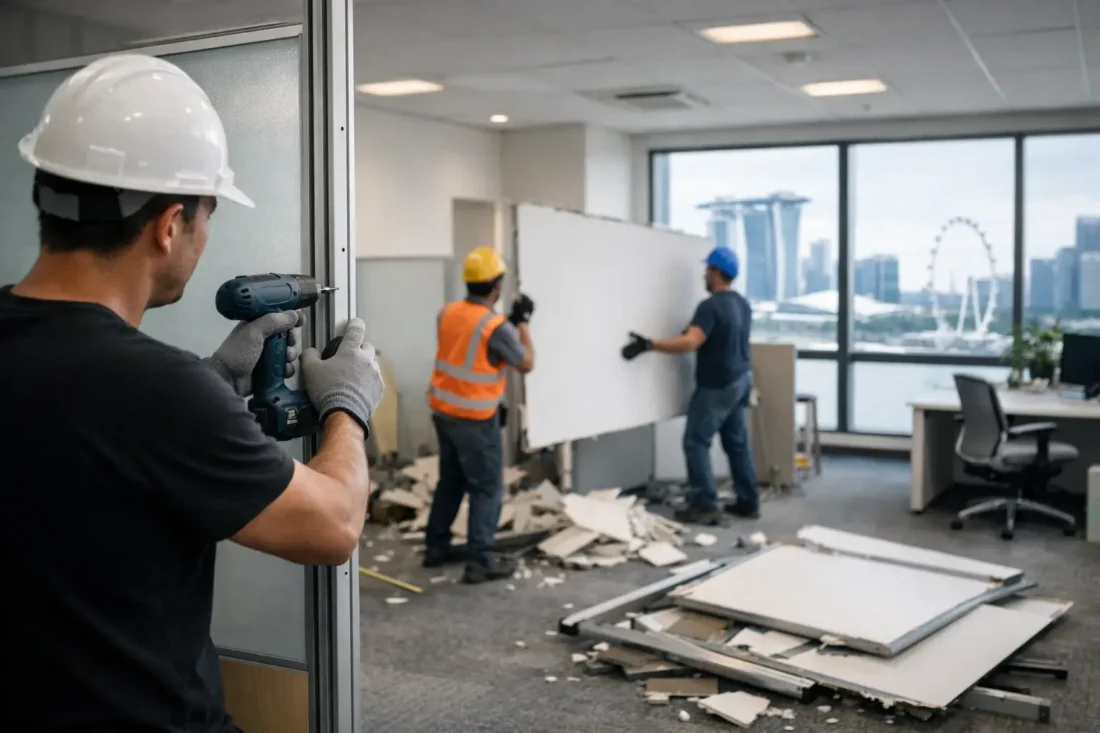
Partition Dismantling Singapore for Lease End
When a landlord says the unit must be returned to original condition, partition dismantling Singapore work often becomes one of the first and most time-sensitive items on the scope. Internal partitions may look straightforward to remove, but in commercial premises they are usually tied to electrical points, ceilings, flooring finishes, access routes and building management rules. If that work is handled badly, the result is not just a messy site – it can mean handover delays, additional rectification and avoidable cost.
For offices, shops, clinics, gyms and other leased premises, partition removal is rarely a standalone job. It sits inside a wider reinstatement requirement, and that is where many tenants get caught out. A wall comes down, but the ceiling grid is damaged, floor tiles are mismatched, wiring is left exposed, or the landlord rejects the condition of the unit because the original layout has not been properly restored.
What partition dismantling Singapore usually involves
In practical terms, partition dismantling means removing non-structural internal divisions that were added during fit-out. These may include gypsum board walls, glass partitions, aluminium framed partitions, timber divisions or demountable office systems. The exact method depends on the material, the fixing detail and the condition the premises must be returned to.
A proper dismantling scope does more than take down the partition itself. It should also address the affected junctions at the ceiling, floor and adjoining walls. Where partitions were built over carpet tiles, vinyl, raised flooring or finished screed, there may be visible lines, fixing holes or surface damage once the wall is removed. The same applies overhead, especially where partition heads cut into ceiling boards, bulkheads or suspended grid systems.
Electrical and data services are another common issue. Many internal partitions contain switches, sockets, data points, trunking or concealed cabling. These cannot simply be left hanging or covered over. They need safe isolation, removal or reinstatement in line with the wider handover requirement.
Why tenants underestimate partition dismantling
The most common mistake is assuming that dismantling is just demolition. It is not. In a lease-end environment, the objective is not merely to clear space. The objective is to restore the unit to a condition acceptable to the landlord, managing agent or building owner.
That means there are always two questions to answer before work starts. First, what exactly must be removed? Second, what must be made good afterwards? If those questions are not settled early, costs can move quickly because the dismantling exposes further defects or reinstatement gaps that were not included in the initial scope.
This is particularly relevant in fitted offices. A partition may connect to custom lighting, air-conditioning diffusers, access control systems, blinds, signage or fire protection adjustments made during the tenancy. Removing the wall without coordinating those related items often creates a second round of work.
The compliance side matters as much as the physical work
Commercial tenants are not judged only on whether the partitions are gone. They are judged on whether the process complies with site rules and whether the final condition meets lease obligations.
In many buildings, dismantling work requires advance approval, work permits, deposit arrangements, lift protection, disposal timing and restricted working hours. Noisy works may only be allowed at certain times. Common areas must be protected. Debris must be removed according to building management procedures. In some premises, especially where glass or heavier framed partitions are involved, method statements and site coordination become more important.
This is why a single contractor with reinstatement experience is usually the safer option than engaging a general demolition team. The work has to be planned around landlord expectations, not just site clearance.
How a proper dismantling process should be managed
The best approach starts with a site review against the tenancy obligations. That means checking the existing partitions, identifying services affected by removal and confirming the original condition required for handover. Some landlords expect complete reversion to base build condition. Others accept a practical make-good standard, provided the unit is clean, safe and functionally restored.
After that, the dismantling sequence should be mapped out properly. Power isolation may be required before removal begins. Furniture, loose equipment and retained fixtures should be protected or cleared. Access routes need to be kept safe, especially in occupied buildings where neighbouring units remain in operation.
The dismantling itself should be controlled rather than rushed. Glass panels need careful handling. Framed systems often need to be disassembled in sections. Drywall partitions should be removed in a way that limits unnecessary damage to adjacent finishes. Once the partitions are down, debris must be cleared promptly so the site can be assessed for the next reinstatement stage.
The make-good phase is where quality shows. Ceiling closures, floor patching, wall repairs, paint touch-ups and service terminations need to be completed so the area does not look like something has simply been torn out. If the dismantling leaves visible scars across the unit, handover discussions can become difficult very quickly.
Partition dismantling Singapore for offices and retail units
Offices and retail spaces tend to have different risks. In offices, the main issue is usually hidden coordination. Meeting rooms, manager rooms and storerooms often contain power, data and ceiling modifications that were built around the partition layout. Removing those walls can reveal more reinstatement work than expected.
In retail units, partitions are often integrated with display systems, back-of-house storage, feature lighting or shopfront-related elements. Finishes also tend to be more visible. A landlord may be less concerned with cosmetic perfection in a bare office floorplate than in a retail unit where floor and wall condition are obvious at first inspection.
For clinics, salons, gyms and F&B premises, another layer of complexity comes in. Partitions may divide treatment rooms, wet areas, service areas or spaces with specialised mechanical and electrical provisions. Dismantling in these environments needs closer coordination with plumbing, ventilation and equipment removal.
Cost, timing and what affects both
There is no honest flat answer to cost because it depends on partition type, quantity, height, site access, disposal requirements and the amount of reinstatement needed after removal. A simple demountable office partition system is usually quicker to remove than a full-height drywall partition tied into the ceiling and floor finishes. Glass partitions may take less time to dismantle structurally but require more careful handling and disposal.
Timing also depends on whether the unit is already vacant. Working in an empty space is faster than dismantling around retained operations, staff movement or remaining assets. Building restrictions can extend the programme as well. If loading, lift usage and noisy works are limited, even a modest dismantling scope can stretch over more days than expected.
The cheapest quote is not always the lowest final cost. If the price excludes electrical disconnection, debris disposal, ceiling and flooring make-good or landlord inspection rectifications, the apparent saving can disappear once the project is underway.
Choosing the right contractor for partition dismantling Singapore
For lease-end works, the right contractor is one that understands reinstatement as a complete obligation, not a collection of isolated tasks. Ask how the partition removal will affect surrounding finishes and services. Ask who is responsible for permits, debris disposal and protection to common areas. Ask what happens if the landlord requests touch-ups before acceptance.
You should also look for scope clarity. A dependable contractor will explain what is included, what assumptions have been made and which areas may need further confirmation after opening up the partitions. That kind of detail is not overkill. It is how disputes and variation shock are reduced.
Office Reinstatement Singapore typically handles partition dismantling as part of a wider end-of-lease programme, which is often the most efficient route for tenants who need one point of contact across removal, restoration, clearance and final handover support.
Where problems usually appear after dismantling
Most post-dismantling issues are predictable. Ceiling boards may not match. Floor finishes under old partitions may be missing, stained or drilled. Painted surfaces can show tone differences after patching. Isolated wiring points may be left in the wrong place. Fire-rated elements may also need attention where the original partition arrangement affected the space.
None of this is unusual, but it does mean the work should be viewed as a restoration exercise rather than a strip-out alone. The more clearly that is understood at the start, the smoother the project tends to run.
If your lease is nearing expiry, the sensible move is to review partition removal early, before the final weeks close in. That gives enough time to confirm landlord requirements, plan the reinstatement properly and complete the handover without the usual last-minute pressure.