


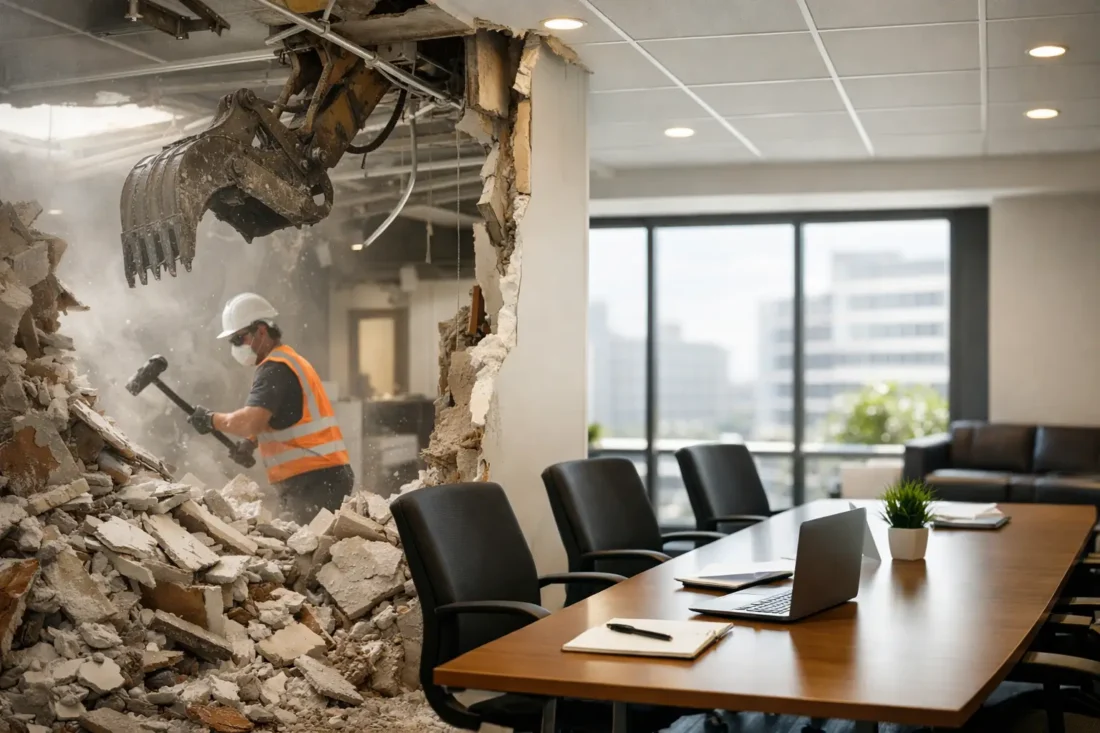
Office Demolition Without Lease-End Risk
When a lease is ending, office demolition is rarely just about tearing things out. The real issue is whether the space is being stripped back in line with the tenancy agreement, the landlord’s reinstatement requirements and the building’s work rules. Get that wrong, and what should be a straightforward handover can turn into rectification costs, delays and avoidable disputes.
For most commercial tenants, the challenge is not deciding whether to remove partitions, carpets or cabling. It is knowing exactly how far the demolition scope should go, what must be preserved, and how to sequence the work so the unit can be restored properly afterwards. In practice, this is why office demolition should be treated as the first controlled phase of reinstatement, not as a standalone strip-out exercise.
What office demolition usually involves
In a leased office, demolition normally covers the removal of tenant-installed items that were added during fit-out. That can include glass and gypsum partitions, doors, flooring finishes, built-in counters, feature walls, loose and built-in furniture, signage, electrical points added for operational use, data cabling, light fittings, plumbing connections, pantry fixtures and air-conditioning units or duct modifications where applicable.
The exact scope depends on the original condition of the unit at takeover. Some offices were handed over as bare units. Others came with landlord-provided ceilings, lighting, carpeting, fire protection coordination or basic mechanical and electrical services. That distinction matters. Removing more than required can be just as problematic as removing too little, particularly where base building systems are involved.
A proper demolition plan starts with documents, not tools. The tenancy agreement, fit-out drawings, deposit conditions and any landlord correspondence should be reviewed first. Without that step, contractors are left guessing what belongs to the tenant and what belongs to the building.
Why office demolition needs to be tied to reinstatement
A common mistake is appointing one party to do demolition and then bringing in separate trades later for patching, restoration and final handover works. On paper, that may look cheaper. On site, it often creates gaps in responsibility.
If a partition is dismantled and the ceiling grid above it is damaged, who is accountable for restoring the ceiling finish? If electrical wiring is removed and circuits are left exposed or undocumented, who ensures the unit is safe and compliant for inspection? If flooring is hacked out and the substrate is uneven, who carries out the repair to return the space to acceptable condition? These are not minor details. They affect cost, programme and landlord acceptance.
That is why office demolition works best when it sits under a full reinstatement scope. The demolition team needs to understand what the end condition should be. That changes how removals are carried out, how surfaces are protected, what must be retained and what follow-up works need to be allowed for.
The biggest risks during office demolition
The most serious risks are usually not dramatic structural issues. They are operational and contractual.
One risk is unauthorised removal. In commercial buildings, certain works may require prior approval, after-hours access, lift protection, disposal arrangements and method statements. If demolition starts before permits or management clearances are in place, the tenant may face work stoppages or penalties.
Another risk is damage to landlord assets. Ceiling boards, sprinkler lines, smoke detectors, raised floors, common corridor finishes and shared services can all be affected during strip-out. Even small damage can lead to claims, especially in premium buildings with strict handover standards.
There is also the risk of incomplete scope. Many tenants assume office demolition ends once visible items are removed. In reality, landlords often check concealed or secondary items such as capped plumbing points, disconnected electrical feeds, patched wall finishes, restored paintwork, cleaned surfaces and disposal records. A unit that looks empty is not necessarily handover-ready.
Finally, there is timing risk. Lease-end periods are usually compressed. Businesses are relocating operations, clearing inventory, coordinating IT migration and managing staff disruption at the same time. If demolition is delayed, every downstream reinstatement activity is delayed with it.
What should be checked before demolition starts
Before any dismantling begins, the existing unit should be assessed against four practical questions.
First, what must be removed under the lease? This should cover all tenant additions and alterations, including works carried out by previous occupants if those obligations were transferred.
Second, what must remain in place? Some lighting, ceilings, fire safety systems or base building services may need to stay untouched unless the landlord specifically instructs otherwise.
Third, what approvals are needed? In many buildings, work permits, insurance submissions, risk assessments, hot work control, debris removal timing and service isolation arrangements must be confirmed in advance.
Fourth, what condition is the unit expected to be in at final handover? Demolition alone does not answer that. The expected end state determines whether patching, repainting, screeding, ceiling infill, M&E termination, cleaning and touch-ups must follow immediately.
This upfront clarity saves time because it reduces rework. It also makes quotation comparisons more accurate. A cheap demolition price can become expensive very quickly if essential reinstatement items were excluded from the initial scope.
How a controlled demolition process should run
A competent office demolition process is methodical. Site protection, service checks and isolation should happen before physical removal begins. Electrical circuits, water supply and any affected HVAC components need to be identified and shut down safely where required. Shared systems should be treated with care so neighbouring occupants and building operations are not affected.
The dismantling itself should follow a logical sequence. Non-structural fixtures and loose items are typically removed first, followed by partitions, ceilings, floor finishes and service connections linked to tenant installations. Waste should be sorted, bagged or bundled appropriately and cleared according to building rules rather than allowed to accumulate unsafely in the unit.
Just as important is what happens after removal. Surfaces need to be inspected, openings patched, exposed services terminated properly and residual damage identified early. A good contractor does not wait until the landlord inspection to discover that floor levels are uneven, wall finishes are inconsistent or electrical points have been left in unacceptable condition.
Cost depends on more than size
Tenants often ask for a demolition rate based on square footage alone. That is understandable, but it is not enough to price the work properly.
Cost is shaped by the density of fit-out, the material types involved, the number of rooms or partitions, after-hours restrictions, disposal logistics, access conditions and the extent of restoration required once demolition is complete. An open-plan office with carpet tiles and a few meeting rooms is very different from a heavily fitted premises with glass partitions, pantry plumbing, custom carpentry, dedicated cooling and extensive electrical alterations.
Programme pressure also affects cost. Expedited works, night shifts and short notice mobilisations are often possible, but they need proper planning. Where the handover date is fixed, speed matters – but it still has to be balanced against safety, compliance and workmanship.
Why single-point coordination matters
At lease end, the operational burden is often as challenging as the physical work. Office managers and facilities teams already have enough to handle without separately managing demolition crews, electricians, painters, flooring teams, disposal vendors and cleaning contractors.
A single contractor managing the full sequence reduces that burden. It means one scope review, one programme, one site coordination process and one accountable party from strip-out through to final touch-ups. It also improves handover readiness because the team carrying out the demolition already knows what the next reinstatement stages require.
This is where a specialist reinstatement contractor adds practical value. Instead of treating office demolition as an isolated task, the work is planned around the landlord inspection, defect clearance and acceptance process. That reduces the chance of end-of-project surprises.
Choosing the right contractor for office demolition
The right contractor should be able to explain the scope in plain terms, identify likely landlord concerns and state clearly what is included after demolition. That includes debris disposal, making good, service terminations, restoration of affected finishes and support during inspection if needed.
It is also worth assessing whether the contractor understands commercial building protocols rather than only general hacking or removal works. Office environments usually involve tighter access controls, more sensitive M&E coordination and stricter expectations around noise, dust management and common area protection.
If the proposal is vague, that is usually a warning sign. Tenants need detail, not assumptions. A dependable contractor should be able to map the work against lease obligations and flag grey areas before the project starts, not after the unit has been stripped.
For businesses that need speed, compliance and a cleaner handover path, Office Reinstatement Singapore approaches demolition as one part of a complete reinstatement plan. That matters because lease-end projects are judged on final acceptance, not just on how quickly the unit was cleared out.
The practical question to ask before work begins
Before approving any office demolition quote, ask one direct question: when the demolition is finished, what exactly will the unit look like, and will that condition satisfy the landlord?
If the answer is uncertain, the scope is not ready. The safest route is always a defined plan that covers removal, restoration, disposal and handover support as one coordinated job. That is how you keep demolition from becoming the reason a lease exit goes off track.
A well-run project should leave you with fewer moving parts, fewer disputes and a space that is ready for inspection, not another round of chasing contractors at the last minute.