


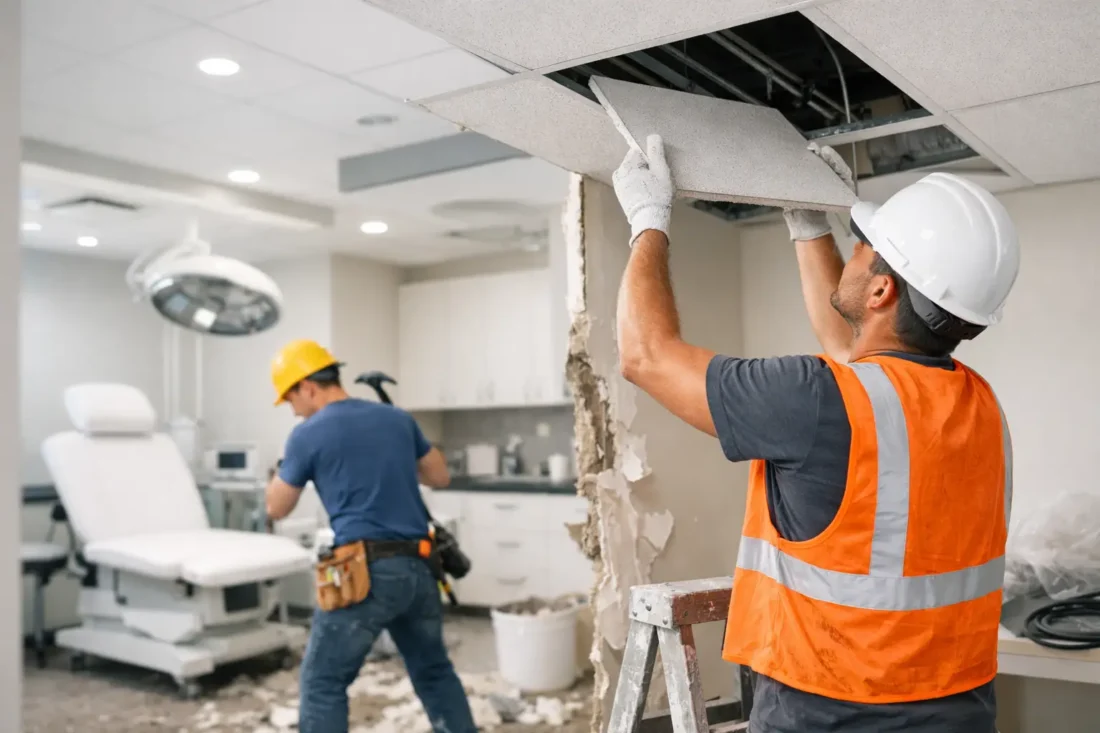
Best Reinstatement Works for Clinics
A clinic handover rarely fails because of one big issue. More often, it unravels over smaller items that were missed – a capped water point done incorrectly, medical joinery left behind, a ceiling not restored to base condition, or landlord specifications that were only checked at the end. That is why the best reinstatement works for clinics are not simply about demolition. They are about controlled, compliant restoration that gets the space accepted without avoidable delay.
Clinics are different from standard offices and shops because the fit-out is usually more technical. Even a compact unit may include treatment rooms, sinks, custom cabinetry, additional power points, data runs, specialised lighting, privacy partitions, vinyl flooring, wall protection and air-conditioning changes. By the time the lease ends, those modifications have to be reversed properly. If the reinstatement contractor does not understand how these elements interact, the job can become fragmented, messy and expensive.
What makes clinic reinstatement more demanding
A clinic interior is often designed around hygiene, patient flow and equipment use. That means the original landlord unit may have been altered more extensively than many tenants realise. Plumbing is commonly extended for consultation rooms and wash areas. Electrical work may have been added for medical devices, illuminated signs and reception counters. Walls are often reconfigured to create private rooms, and flooring may be upgraded for durability and cleaning requirements.
When reinstatement starts, each of these additions has to be assessed against the original handover condition and the lease requirements. Some landlords want the unit returned to bare condition. Others require reinstatement only to a specific baseline. The difference matters. Removing too little creates disputes. Removing too much can also waste money and time.
This is where experience matters. The best reinstatement works for clinics begin with a proper site review, document checking and scope confirmation before any dismantling starts. That reduces the risk of rework and helps the outgoing tenant budget accurately.
Best reinstatement works for clinics start with the lease
Before tools come out, the tenancy agreement, approved fit-out drawings and any building management conditions should be checked carefully. This is not admin for its own sake. It defines the reinstatement target.
For clinics, there are often additional layers to consider. Mechanical and electrical alterations may have been approved separately. Water supply and discharge points may have been relocated. Fire safety interfaces, access control devices and ceiling works may also have passed through landlord or management approval during the original fit-out. At lease end, the contractor needs to know what must be removed, what must be restored and what has to be documented for final inspection.
A practical contractor will not treat all clinics the same. An aesthetics clinic, dental practice, specialist consultation suite and general outpatient unit can each have very different reinstatement scopes. The right approach is to map the actual unit condition against the required handover condition, then produce a scope that covers all relevant trades.
Scope that usually matters most in a clinic reinstatement
The bulk of clinic reinstatement tends to sit across partitions, ceilings, flooring, electrical, plumbing and air-conditioning. But the detail inside each trade is where projects either stay on track or start generating variation costs.
Partition and built-in removal
Many clinics use lightweight partitions to create consultation rooms, treatment spaces, storage and reception enclosures. These are often tied into ceiling grids, floor finishes and electrical routes. Removal has to be done carefully so that the surrounding finishes can be restored without visible patchwork.
Built-in counters, dispensary cabinets, treatment room joinery and wall-mounted storage should also be dismantled cleanly. If they are removed roughly, there is usually a knock-on effect on walls, skirting, flooring and services.
Plumbing and sanitary reinstatement
This is one of the most sensitive areas in clinic projects. Hand wash basins, treatment sinks and concealed pipe runs are common. Once those fixtures are removed, the remaining plumbing points need to be capped and reinstated properly in line with building requirements.
Poor plumbing closure creates immediate risk at inspection stage. Leaks, exposed pipework and unfinished wall repairs are the kind of defects landlords and managing agents spot quickly. The right contractor plans plumbing reinstatement together with wall and floor restoration, not as a separate afterthought.
Electrical and data restoration
Clinics often have extra sockets, isolated circuits, signage feeds, data points and switched lighting layouts. Reinstatement usually involves removing redundant points, making safe terminations and restoring the electrical system to the original provision expected by the landlord.
There is a practical balance to strike here. Some units require full removal of added services. Others may allow certain retained infrastructure if approved. A contractor that checks this early can prevent unnecessary cost.
Ceiling, flooring and painting
Once partitions, signs and services are removed, the surface repairs begin. Ceiling boards may need replacement. Grid ceilings may need re-alignment. Flooring often needs patching or full restoration if fixed furniture and room divisions have left obvious scars.
Paintwork is not just cosmetic at this stage. Uneven patches, exposed screw holes and inconsistent finishes can affect acceptance. A handover-ready unit should look complete, not partially repaired.
Air-conditioning and ventilation adjustments
Some clinics add FCUs, ducting changes, diffusers or relocated controls to suit room layouts. These changes need to be reversed where required by the original landlord condition. This can be more technical than it first appears, especially where ceiling reinstatement and M&E works overlap.
Why a single contractor is usually the safer option
Clinic reinstatement is rarely a one-trade job. The tenant who appoints separate demolition, electrical, plumbing, painting and disposal teams may think this will reduce cost, but it often creates coordination gaps. When something is missed, each contractor can point elsewhere.
A single reinstatement contractor provides one scope, one programme and one point of accountability. That matters when the handover deadline is fixed and the landlord inspection is approaching. It also makes cost control easier because hidden dependencies are identified earlier. For example, removing a treatment sink may trigger wall making-good, vinyl replacement and repainting in the same area. If the job is priced and managed as one package, there are fewer surprises.
For commercial tenants, this is often the real definition of value. The best contractor is not necessarily the one with the lowest starting quotation. It is the one most likely to finish on time, meet the lease condition and avoid expensive disputes at the end.
How to assess the best reinstatement works for clinics
A good clinic reinstatement proposal should be clear about scope, exclusions, programme and handover support. If the quotation is vague, the project risk stays with you.
Look for a contractor that asks for the tenancy agreement, existing drawings and landlord requirements upfront. That is usually a sign they understand compliance, not just dismantling. They should also be able to explain how they will manage debris removal, protection of common areas, permit coordination where required, and defect rectification if inspection comments arise.
Trade coverage matters as well. If plumbing, electrical, ceiling, flooring, painting and disposal all have to be subcontracted ad hoc after commencement, project control becomes weaker. The strongest reinstatement providers handle these works as an integrated process with proper supervision.
In Singapore, building management standards and handover expectations can vary from one development to another. A contractor with relevant commercial reinstatement experience will usually know how to work around access restrictions, loading hours, permit procedures and inspection requirements without turning every issue into a delay claim.
Common mistakes clinic tenants make
One common mistake is starting too late. Clinics often stay operational until close to lease expiry, which compresses the reinstatement window. That can be done, but only if the scope is prepared properly in advance.
Another mistake is assuming all added works can simply be removed without checking approval history or original landlord condition. In practice, some items need specific treatment, and some areas need more restoration than expected once built-ins are dismantled.
The third mistake is choosing purely on price. Low quotations can exclude disposal, M&E reinstatement, permit handling or final touch-ups. Those omissions only become visible when the deadline is near and the landlord inspection list grows.
What a smooth clinic handover should look like
A well-managed clinic reinstatement finishes with the unit in a clean, compliant and inspection-ready state. Removed items are cleared. Services are made safe. Surfaces are restored. The space reflects the agreed handover condition rather than a half-finished strip-out.
Just as important, the contractor should be ready to support the final stage, whether that means attending inspection, addressing minor comments or helping close out landlord requirements quickly. That final stretch is where many tenants feel the most pressure, especially when deposit recovery is at stake.
Office Reinstatement Singapore approaches projects with that practical outcome in mind – complete scope control, proper restoration and fewer handover issues at the point they matter most.
If your clinic lease is ending soon, the right time to review the reinstatement scope is before operations stop, not after. A careful site assessment now can save a rushed, disputed handover later.