


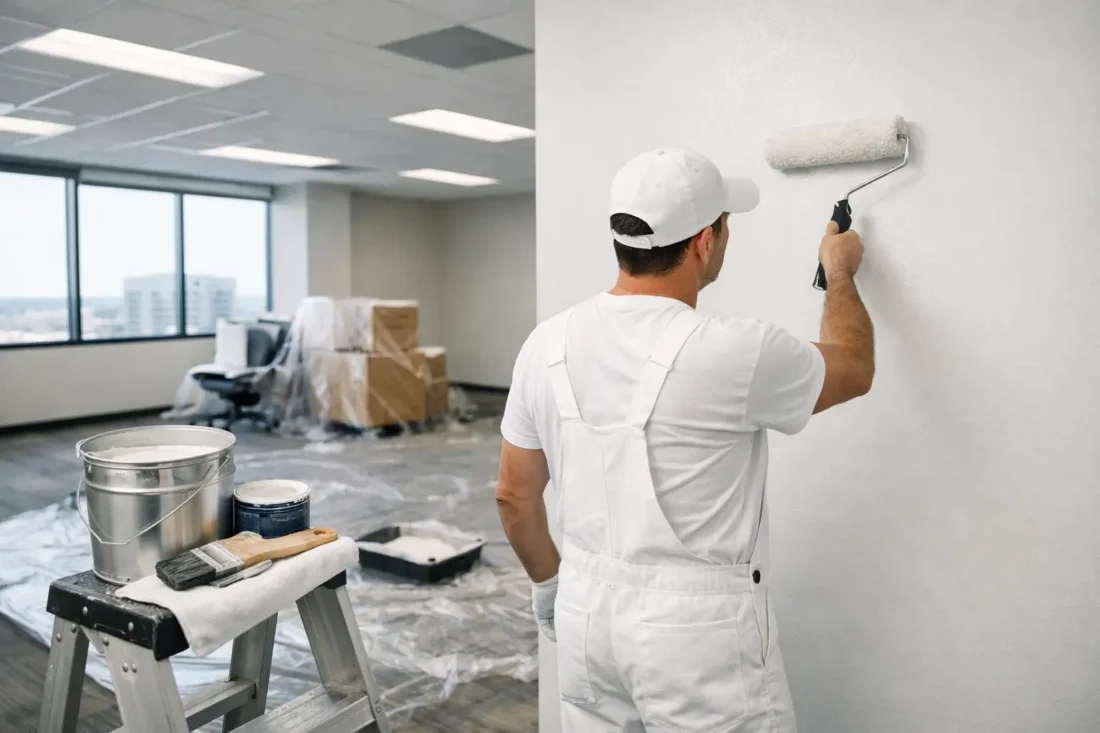
Painting After Office Removal Done Right
The walls usually tell the story first. Once workstations are cleared, partitions are dismantled and signage comes down, what looked like a tidy office often reveals patch marks, uneven paint tones, anchor holes, cable damage and stained ceilings. That is why painting after office removal is not a cosmetic extra. It is often one of the final steps that determines whether the unit looks reinstated properly or still appears mid-strip-out.
For commercial tenants, this matters because landlords and managing agents do not assess handover based on effort. They assess the finished condition against lease requirements, building expectations and the original state of the premises. A rushed paint job can leave visible defects that trigger rectification requests, inspection delays or deposit disputes. A properly planned one helps present the unit as clean, complete and ready for acceptance.
Why painting after office removal matters
Painting sits at the end of several reinstatement trades, but it is linked to all of them. When partition walls are removed, surfaces need patching. When electrical points are relocated or redundant trunking is taken out, there may be chases, holes and mismatched finishes. Ceiling works, air-conditioning removal, signage dismantling and flooring adjustments can all leave marks that must be made good before painting begins.
If painting starts too early, later trades can damage completed surfaces. If it starts too late, handover can be pushed back. The practical issue is sequencing. Good reinstatement planning treats painting as part of the overall programme, not as an isolated add-on.
There is also the compliance side. Some leases require reinstatement to original colour schemes or landlord-approved finishes. Others are less specific and focus on the unit being returned in good, rentable condition. The difference matters. In one case, exact paint matching may be required. In another, a fresh, uniform commercial repaint may be accepted. The right approach depends on the tenancy agreement, the condition of adjoining surfaces and the landlord’s inspection standard.
What a proper office repaint should cover
Painting after office removal is rarely just about applying a fresh coat. The quality of the result depends on the preparation work underneath it. If existing defects are not repaired properly, they will still show through, particularly under strong office lighting.
A proper scope typically includes surface inspection, removal of loose material, crack and hole filling, skim coating where required, sanding, stain treatment, primer application and final coats to walls, ceilings or both. In some cases, door frames, skirting, columns and service boxing also need repainting to restore a consistent finish.
The extent of work depends on what was removed from the space. An office with extensive glass partitioning may only need localised making good. A unit that had built-in carpentry, branding panels, feature walls and heavy cabling may need broad surface repairs before any paint can be applied. Retail and F&B spaces can be even more demanding because grease, moisture or customer wear often affect the substrate condition.
This is where commercial experience matters. A contractor handling reinstatement should know that painting quality is shaped long before the first roller touches the wall.
Common issues found before painting after office removal
The most frequent problem is unevenness. Once partitions are taken out, the wall behind them often has a different paint tone, less sun exposure or a rougher surface. Even if the colour is technically similar, the contrast can still be obvious. Spot painting in these situations is usually a false economy.
Another common issue is failed patching. Small holes from screws and fixings are easy enough to fill, but larger service penetrations, hacked cable routes or damaged plasterboard sections require more careful repair. If the substrate is not stabilised and levelled correctly, the repaired area can flash through the final coat.
Ceilings deserve similar attention. Removal of light fittings, diffusers, sprinklers, sensors or suspended services can leave discolouration and repair lines. On white ceilings, these defects stand out quickly, especially under daylight or bright LED fittings used during inspection.
There is also the question of old versus new paint. If the original coating is chalky, peeling, damp-affected or contaminated, repainting directly over it can lead to failure. In these cases, extra preparation and priming are not optional. They are the only way to avoid bubbling, poor adhesion or recurring stains.
Choosing the right scope for landlord handover
Not every unit needs a full repaint, but many do. The decision should not be based only on cost. It should be based on whether partial rectification can achieve a visibly uniform, handover-ready result.
Localised painting may work where removals were limited and the existing finish is still in sound condition. For example, a small office with minor signage removal and a few patched cable points may only need targeted making good and repainting to affected sections. That said, if adjacent walls have aged differently, touch-ups can look more obvious than a full repaint.
A full repaint is generally the safer route when there have been major layout changes, substantial dismantling works or long tenancy periods. It creates a consistent appearance across the space and reduces the risk of inspection comments about visible patchwork. For large commercial premises, this can also speed up final acceptance because the unit presents as complete rather than partly rectified.
The right contractor will advise based on practical inspection, not guesswork. If your lease or landlord has specific reinstatement expectations, the paint scope should be aligned before work starts rather than negotiated after defects are raised.
Timing and coordination on reinstatement projects
Painting is one of the last major finishing trades, but it cannot simply be left to the final day. Drying times, curing conditions, access constraints and follow-on cleaning all need to be factored into the programme.
In an occupied building, there may also be restrictions on work hours, loading access, noise control and disposal arrangements. If the repaint depends on earlier dismantling, hacking, M&E removal or ceiling restoration, any delay upstream affects the finish stage. That is why single-source project management is often more reliable than splitting the job across multiple contractors.
With one coordinated reinstatement team, surface repairs, painting, cleaning and touch-up works can be sequenced properly against inspection deadlines. This reduces the usual problems – painters arriving before patching is complete, exposed walls being damaged by later trades, or handover cleaning being done before final paint touch-ups.
For businesses working against lease expiry, these details are not minor. They directly affect whether the premises can be returned on time.
Quality checkpoints that actually matter
A commercial repaint should be assessed on more than whether the walls look fresh from a distance. Close inspection matters because landlords and asset teams often look for consistency, coverage and visible defects at eye level.
The finish should be uniform in colour and sheen, with no obvious roller marks, patch flashing, drips or rough repaired spots. Cut lines around ceilings, columns and frames should be neat. Filled holes should not sink after drying. Stains should not bleed through. Most importantly, the paint should sit over surfaces that have been repaired properly, not merely covered quickly.
Good contractors also build in final touch-up after debris clearance and deep cleaning. That step is useful because minor marks often appear once ladders, dismantled materials and disposal bags are removed from the site.
Why painting is best handled within a full reinstatement scope
Painting after office removal is one of those items that seems simple until it is separated from the rest of the reinstatement works. Then the problems start. One contractor patches, another paints, a third removes final fittings, and no one takes responsibility when defects overlap.
An end-to-end reinstatement contractor avoids that gap. Surface repairs are carried out with the painting requirement in mind. Ceiling making good is coordinated with M&E removal. Final finishing is scheduled around inspection and handover. If the landlord requests rectification, there is one accountable party managing it.
That is the practical advantage businesses are really paying for – not just paint on a wall, but a unit that can be handed back with fewer disputes and less internal coordination. For occupiers vacating offices, retail units or fitted commercial spaces, that can save more than money. It saves time, management effort and avoidable back-and-forth at the worst possible stage of a lease.
Office Reinstatement Singapore approaches painting the same way it handles the rest of reinstatement works – as part of a complete handover solution, not a disconnected finishing trade.
If your premises are being stripped back for lease return, treat painting as the final proof of proper reinstatement. When the repairs, preparation and timing are done right, the whole unit reads as complete – and that is usually what gets handover across the line.