


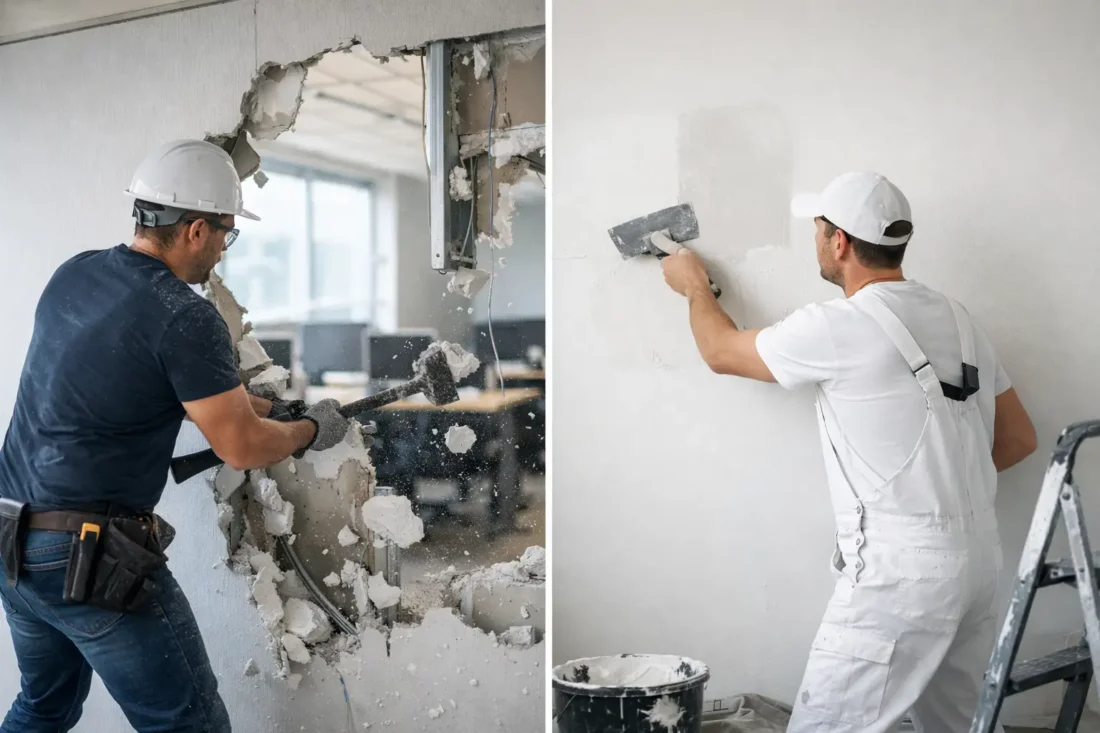
Partition Removal vs Wall Restoration
When a lease is ending, the real question is rarely whether a partition has to come down. The bigger issue in partition removal vs wall restoration is what the landlord expects the space to look like after that partition is gone. Many handover disputes start here – not with dismantling works, but with the condition of the wall, floor, ceiling and services left behind.
For office managers, tenants and facilities teams, this distinction matters because partition removal is only one part of reinstatement. If you budget for dismantling but not for proper restoration, the job can stall at final inspection. That is when minor defects suddenly become costly delays.
Partition removal vs wall restoration – what is the difference?
Partition removal is the physical dismantling and disposal of non-structural internal divisions. This usually includes gypsum board partitions, glass partitions, aluminium-framed systems, lightweight dividers, doors, ironmongery and any related fixtures fixed to the partition line. The scope is about taking something away safely without damaging the surrounding premises.
Wall restoration begins after that. It covers making good the surfaces and finishes exposed by the removal works so the unit is returned to the required original condition. That can mean patching ceiling and floor finishes, repairing adjacent walls, repainting, reinstating skirting, closing electrical points, removing data cabling, and levelling visible scars where the partition once stood.
In practical terms, partition removal clears the space. Wall restoration makes the space handover-ready.
That difference affects cost, programme and responsibility. A contractor can remove partitions quickly, but if the restored area does not match landlord requirements, the unit may still fail inspection. For lease-end projects, compliance sits with the finished result, not just the dismantling process.
Why tenants often underestimate wall restoration
Partitions leave evidence behind. Even clean removals usually expose uneven paint tones, anchor holes, ceiling grid interruptions, floor track marks and service penetrations. If the original office layout included multiple meeting rooms, manager cabins or reception enclosures, the amount of making good can be substantial.
This is where assumptions become risky. Some tenants believe that once the partition is removed, a simple coat of paint will solve the issue. Often it will not. If there are cut ceiling tiles, missing carpet tiles, damaged vinyl, shifted sprinkler heads, rerouted lighting or power points mounted on the partition, restoration becomes a multi-trade exercise.
The landlord or building manager is usually assessing whether the premises has been reinstated to the agreed base condition, not whether the demolition was neatly done. A visible line on the floor or an unmatched wall finish can still trigger rectification.
What partition removal typically includes
A proper partition dismantling scope should start with site protection and a check on what is hidden inside the partition. Electrical wiring, data points, switches, air-conditioning controls and sometimes plumbing lines may have been run through or fixed onto the partition system.
The work generally includes disconnecting affected services, dismantling the partition panels or framed sections, removing doors and glazing where applicable, disposing of debris, and clearing the area for follow-on restoration. Depending on the building, there may also be restrictions on working hours, lift usage, loading bay access and debris removal routes.
For commercial units, safe dismantling is only part of the requirement. The contractor also needs to manage noise, dust, protection of common areas and coordination with building management. In occupied buildings, that administrative side matters almost as much as the physical work.
What wall restoration usually needs after partition removal
Restoration scope depends on the original fit-out and what the lease requires, but several items come up repeatedly.
The floor usually needs attention first. Carpet tiles may have faded differently under sunlight, so replacement pieces can stand out. Vinyl or timber-look flooring may show screw holes, adhesive residue or track marks. Tiled finishes can leave a line where the partition sat, and matching older tiles is not always straightforward.
The ceiling is another common problem area. Removed partitions often reveal cut tile edges, missing sections of grid, misaligned lights or sprinkler coverage that no longer suits the open layout. If the original unit had a standard suspended ceiling, reinstatement may involve tile replacement and service reconfiguration rather than cosmetic patching alone.
Walls and columns adjacent to the old partition line also need making good. There may be fixing holes, chips, sealant stains or inconsistent paint finish. If the landlord expects the unit returned to original colour specifications, repainting may need to extend beyond the immediate patch area to achieve a uniform result.
Then there are the concealed trades. Electrical points fixed on the partition have to be removed or terminated safely. Data cabling cannot simply be left hanging above the ceiling. Fire protection devices, smoke detectors and access control components may need removal, relocation or formal sign-off depending on building rules.
Which matters more at lease end?
If the goal is successful handover, wall restoration matters more than many tenants expect. That does not make partition removal less important, but dismantling on its own does not satisfy reinstatement obligations.
Landlords do not usually charge penalties because a partition took too long to remove. They impose rectification requirements because the premises has not been restored properly. The commercial risk sits in the visible and technical defects left after removal works are completed.
This is why end-to-end scope matters. When dismantling and restoration are split between different parties, responsibility can become blurred. One contractor may say the wall finish problem came from earlier demolition. Another may say the floor damage existed already. Meanwhile, the handover date does not move.
Cost differences and where budgets go wrong
Partition removal is often the easier part to price at the start. The quantities are visible, access can be assessed, and disposal volume is reasonably predictable. Wall restoration is where variation risk increases.
Costs can rise if matching materials are unavailable, if hidden services are discovered, or if building management requires after-hours work. Even small changes can affect budget. A glass partition removal may seem straightforward until it becomes clear that floor boxes, card access and modified sprinkler positions all need reinstatement works.
The cheapest quotation is not always the lowest final cost. If a price only covers dismantling and debris disposal, the tenant may still need separate trades for painting, flooring, electrical making good, ceiling repairs and final cleaning. That fragmented approach often leads to coordination delays and additional call-backs.
A more reliable way to budget is to treat partition removal and restoration as one connected handover package. That gives a clearer picture of the true lease-end requirement rather than just the demolition line item.
When simple removal is enough – and when it is not
There are cases where removal alone may be close to sufficient. If the partition is freestanding, lightly fixed, and installed over finishes that remain intact once it is removed, the making-good scope may be minimal. This is more likely in modern modular office systems designed for reconfiguration.
But in many leased premises, partitions were built into the fit-out rather than placed on top of it. Once removed, they expose breaks in finishes and service layouts that cannot be ignored. Retail units, clinics, gyms and F&B spaces tend to have more integrated installations, so restoration requirements are usually broader.
It also depends on the lease and any fit-out approval records. Some landlords expect reinstatement to shell-and-core or to a defined original handover condition. Others accept a more limited return if certain works were landlord-approved improvements. The only safe approach is to verify the required end state before work starts.
How to approach the job properly
The first step is to review the tenancy agreement, approved fit-out drawings and any landlord reinstatement notes. These documents define whether the partition is simply being removed or whether full surface and services restoration is required.
After that, a site assessment should map every affected trade, not just the partition line. Look at flooring continuity, ceiling integrity, M&E services, fire protection impact, repainting extent and debris removal logistics. This is where experienced reinstatement contractors add value, because they price and plan for the knock-on work rather than pretending it does not exist.
Before works begin, it also helps to align expectations with building management. In Singapore commercial buildings, access permits, work timing restrictions, lift bookings and disposal procedures can influence the programme significantly. A technically sound scope can still run into delays if these approvals are not managed properly.
For tenants who want fewer moving parts, a single contractor handling dismantling, restoration, waste disposal and inspection support is usually the lower-risk route. That is the reason many clients engage Office Reinstatement Singapore for complete lease-end execution rather than isolated trade packages.
The handover standard is the real benchmark
In partition removal vs wall restoration, the deciding factor is not which task looks bigger on paper. It is which one determines whether the landlord accepts the unit. Most of the time, that answer is restoration.
A partition can be gone in a day or two. Rectifying poor making-good can take much longer, especially if it involves ceilings, flooring, electrical terminations and repainting across the unit. When deadlines are tight, the focus should be on the final accepted condition, not just the speed of dismantling.
If you are planning lease-end works, treat partition removal as the start of the obligation, not the end of it. The smoother handovers usually come from teams that ask a harder question at the beginning: once the partition disappears, what exactly must the premises look like for the landlord to sign off without argument?