


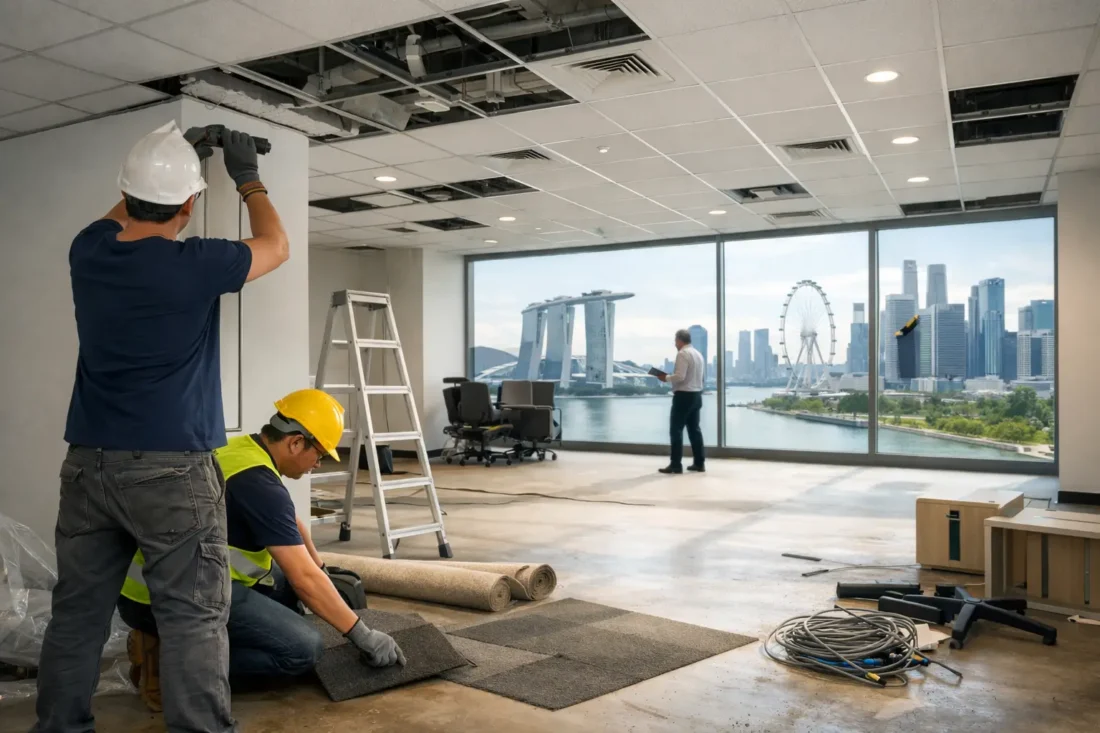
Reinstatement Singapore for Lease-End Handover
When a lease is ending, most problems do not start on the last day. They start weeks earlier – when the unit still has custom partitions, extra power points, branded signage, raised flooring, data cabling, and fittings that were never part of the original handover condition. That is why reinstatement Singapore work is not just a contractor job. It is a lease compliance exercise with commercial consequences.
For office managers, business owners, and operations teams, the risk is straightforward. If the premises are not returned in the required condition, you may face handover delays, deductions from your deposit, extra rental, or disputes with the landlord and building management. The right reinstatement approach removes that risk by treating the project as a controlled handover, not just a strip-out.
What reinstatement Singapore usually involves
In practical terms, reinstatement means restoring a leased commercial unit to the condition required under the tenancy agreement, fit-out guide, or landlord instruction. That may mean returning the space to its original shell condition, or it may mean removing only the tenant’s additions while keeping selected base building elements intact. The difference matters, because over-removing can be just as costly as under-delivering.
A proper scope often covers partition dismantling, demolition of built-in counters and storage, removal of vinyl, carpet tiles or other floor finishes, and making good affected surfaces. Ceiling restoration may include replacing damaged boards, removing suspended features, and reinstating lighting points according to approved layouts. Electrical and plumbing works are also common, especially where tenants have added distribution boards, sockets, lighting runs, water points, pantry fixtures, or drainage lines.
In some premises, HVAC removal is part of the job. In others, only branch ducting, FCU relocations, or supplementary air-conditioning units need to be taken out. Retail units may need signage removal, glass film stripping, frontage making good, and restoration of shopfront finishes. Industrial and warehouse occupiers may need racking removal, office mezzanine dismantling, epoxy floor repair, or reinstatement of fire safety provisions affected by prior fit-out works.
Why lease-end reinstatement is rarely as simple as it looks
A vacant unit can look close to handover-ready while still failing inspection. The usual reason is that reinstatement is judged against documents and site conditions, not appearances. Landlords and managing agents often compare the final space against the original handover record, approved drawings, fit-out submissions, and tenancy clauses. If any element remains that should have been removed, or if any damaged area has not been properly made good, the unit may be rejected.
This is where experience matters. A contractor handling reinstatement Singapore projects needs to understand more than demolition and repair. They need to work around permit requirements, building access rules, disposal procedures, after-hours restrictions, lift protection, and inspection expectations. In commercial buildings, technical compliance and coordination are often what determine whether handover goes smoothly.
There is also the sequencing issue. Removing partitions before isolating electrical runs can create avoidable damage. Tearing out flooring before confirming landlord expectations may expose slab conditions that require extra rectification. Leaving painting until after final dismantling sounds efficient, but it can backfire if patching continues late into the programme. Good reinstatement work is not only about the trade scope. It is about the order of execution.
How to plan reinstatement without disrupting your exit timeline
The best time to start is usually earlier than tenants expect. Once notice of non-renewal or relocation is confirmed, the reinstatement scope should be reviewed against the tenancy agreement and the actual site condition. Waiting until the office move is complete may feel logical, but it compresses the programme and leaves less room for approvals, rectification, and inspection.
A practical process starts with a site survey. This identifies what was added during occupation, what must be removed, what can remain, and what repairs will be needed once dismantling begins. It is also the stage where access constraints, debris disposal arrangements, and working hours should be confirmed. In many buildings, these are not minor details. They shape cost, duration, and manpower planning.
After the survey, the reinstatement scope should be itemised clearly. Ambiguity is expensive at lease end. If painting is included, state which areas. If M&E removals are required, define whether isolation, dismantling, capping, testing, and making good are part of the package. If final cleaning is expected before landlord inspection, that should be included from the outset rather than treated as an afterthought.
Programme management is equally important. Businesses often need to align exit works with movers, IT decommissioning, furniture disposal, and internal asset recovery. A single contractor managing multiple trades reduces coordination risk and shortens the handover path. That is often more valuable than chasing the lowest quote across separate demolition, electrical, painting, and cleaning vendors.
Reinstatement Singapore projects: common cost drivers
Cost depends on scope, access, condition, and compliance requirements. The size of the premises matters, but it is not the only factor. A small office with extensive built-ins, data cabling, glass partitions, and customised lighting can be more demanding than a larger open-plan unit with minimal alterations.
The biggest cost drivers usually include the extent of demolition, the amount of making good required after removals, specialist trades such as electrical, plumbing, air-conditioning, and the disposal volume. Night work or restricted working hours can also raise costs because labour and logistics become less efficient. Buildings with strict permit processes or limited loading access may require more supervision and tighter sequencing.
One point worth noting is that the cheapest price is not always the safest commercial decision. If the quote excludes key items such as haulage, patch repairs, permit coordination, final touch-ups, or cleaning, the project can end up costing more once variations begin. At lease end, omissions are rarely harmless. They tend to surface when time is already running short.
What to look for in a reinstatement contractor
The contractor should be able to review tenancy requirements, inspect the unit properly, and explain the likely handover issues before work begins. That is a basic indicator that they understand commercial reinstatement rather than general renovation.
You should also look for breadth of trade coverage. Reinstatement usually cuts across demolition, carpentry removal, flooring, ceiling works, painting, electrical, plumbing, HVAC, cleaning, and debris disposal. If these are managed separately without strong coordination, delays and finger-pointing become more likely.
Clarity matters as much as capability. A dependable contractor will define the scope, exclusions, timeline, and handover support clearly. They should also be prepared for the reality that some rectification may be needed after the first inspection. A smooth project is not one with no issues at all. It is one where issues are anticipated, resolved quickly, and closed out without disrupting the lease-end schedule.
This is why many businesses prefer a single point of contact. Office Reinstatement Singapore, for example, is built around that model – complete reinstatement works, coordinated across trades, with practical support through inspection and landlord handover. For tenants managing a move, that reduces operational burden at exactly the stage when time is least flexible.
The handover stage is where reinstatement succeeds or fails
A reinstatement project is only complete when the landlord or managing agent accepts the premises. That final stage often reveals the difference between a contractor who simply finishes the work and one who delivers a handover-ready result.
Pre-handover checks should cover finishes, patching, paint consistency, exposed services, capped points, ceiling alignment, floor condition, and the removal of all tenant fixtures and waste. Any documentation required by building management should be prepared in advance, especially where permits, disposal records, or service terminations are involved. If the landlord raises defects, rectification should be dealt with quickly and methodically.
There is always some variation between properties. A Grade A office tower, a retail mall unit, a clinic, and a warehouse do not follow exactly the same reinstatement logic. But the commercial objective is the same in every case: return the premises in the required condition, avoid unnecessary penalties, and close the tenancy cleanly.
If your lease is ending soon, the safest move is not to wait for the unit to become empty before planning. Get the scope assessed early, align the works with your exit programme, and treat reinstatement as part of the handover strategy rather than a last-minute clean-up job. That is usually the difference between a controlled exit and an expensive delay.